
When auto shops lack a content calendar, they face inconsistent marketing, missed seasonal opportunities, and uncoordinated promotions. This leads to erratic customer flow, reduced visibility, and lost trust. A content calendar solves these problems by helping shops:
- Plan and schedule posts consistently to maintain visibility.
- Align marketing efforts with seasonal trends to boost revenue.
- Avoid last-minute promotions that confuse customers and overwhelm staff.
Key stats:
- 77% of auto shop customers research online before visiting.
- Businesses using content calendars see a 60% efficiency boost and 30% more engagement.
- Shops with year-round promotions retain 83% of customers, compared to 51% for others.
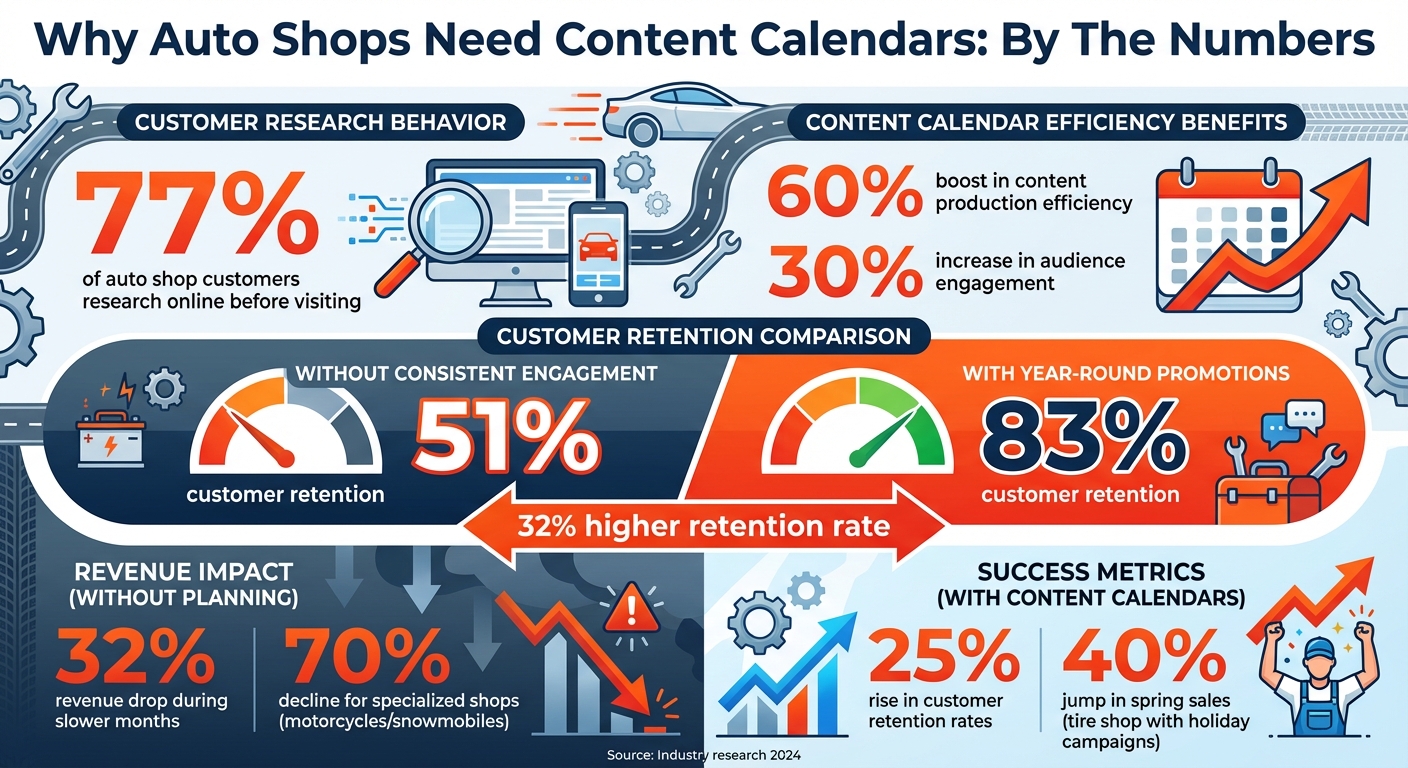
Auto Shop Content Calendar Benefits: Key Statistics and Impact
You NEED a Marketing Plan! Here’s Why | Weekly Blitz Ep. 209
Marketing Problems Auto Shops Face Without Content Calendars
Without a content calendar, auto shops often find themselves dealing with scattered strategies that can hurt their reputation and bottom line.
Inconsistent Posting Hurts Visibility
When auto shops post irregularly on social media or let their blogs sit idle for weeks, their online presence takes a hit. This lack of consistency weakens credibility and makes it harder to convert online visitors into paying customers.
Regular blog updates with relevant keywords can help improve your shop’s Google rankings, but it takes months of steady effort to see results. On the flip side, long gaps between posts or rushed, low-quality content can do more harm than good.
"By planning out your calendar, you’ll provide content that shows you as a trusted advisor. It helps you present your information on a month-to-month basis and consistently keeps you top of mind as the product expert with your current and future customers."
- Steve Mitchell, Contributing Writer, CBT News
Without consistent content, you miss out on reaching potential customers who are actively searching for services. This inconsistency not only reduces online engagement but also causes you to overlook seasonal trends that could boost revenue.
Missing Seasonal Revenue Opportunities
Failing to plan around seasonal trends can lead to serious financial setbacks. For instance, auto repair shops typically see a 32% revenue drop during their slower months. For specialized shops, like those focusing on motorcycles or snowmobiles, this decline can spike to 70%. On the other hand, shops with year-round, diversified services enjoy an 83% customer retention rate, compared to just 51% for those without a consistent engagement plan.
A content calendar helps you align your marketing with seasonal needs, such as promoting winterizing services, A/C checks, or summer road trip inspections. For example, a shop in North Carolina managed to counteract seasonal slowdowns by rolling out promotions tied to local events.
Local happenings like state fairs, sporting events, or even weather changes can lead to predictable dips in customer traffic. By marking these occasions on your calendar and planning targeted campaigns, you can avoid slow periods and keep your bays busy. Seasonal strategies not only drive revenue but also ensure your messaging stays clear and coordinated.
Unplanned Promotions Create Confusion
Last-minute promotions often come across as poorly thought out. When shops rush to create offers without proper planning, it can lead to inconsistent messaging – your website might show one deal while your social media advertises something entirely different. This disjointed communication confuses customers and makes it harder to measure campaign success.
"Planning out your holiday tactics in advance gives you the time to study consumer trends and behavior as well as outline your campaigns so you don’t have to think on the fly."
- Benjamin Johnson, Tekmetric
A well-structured marketing plan allows you to track results and refine what works. Rushed promotions not only waste resources but also miss the chance to engage customers who are ready to book.
Additionally, unplanned campaigns can overwhelm your staff if they unexpectedly generate a surge in interest. This can lead to a chaotic "feast-or-famine" cycle, where your team swings between being overbooked one week and underutilized the next. Planning ahead ensures smoother operations and a better customer experience.
How Content Calendars Fix Marketing Problems
A content calendar is a powerful tool to tackle common marketing challenges, such as visibility issues, missed seasonal opportunities, and uncoordinated promotions. By planning ahead, you can take control of your messaging and timing, ensuring your marketing efforts are both consistent and impactful.
Keeping Your Content Flow Consistent
When you schedule blog posts, social media updates, and email campaigns in advance, you eliminate the risk of disappearing from your audience’s radar. Businesses that post on social media at least three times a week are more likely to keep their followers engaged and maintain a strong presence. Plus, having a plan in place helps your team stay prepared for spikes in customer inquiries.
This kind of foresight also avoids the stress of last-minute campaigns that can overwhelm your staff and lead to missteps.
Aligning Content with Seasonal Trends
A content calendar allows you to map out your marketing strategy for the entire year, ensuring you’re ready for key seasonal events. For example, you can schedule promotions for winter tire changes in October or A/C maintenance reminders in April, addressing customer needs when they’re most relevant. This approach can help stabilize revenue during slower periods.
It’s also a great way to tie your marketing to local events. If your town hosts a big fair in September, you can plan content that taps into the local excitement. Some businesses even get creative with quirky dates, like celebrating National Barbeque Month in May with customer appreciation events. These efforts not only boost sales but also create meaningful connections within your community.
By timing your content strategically, you not only improve revenue opportunities but also enhance internal communication, making it easier for your team to collaborate effectively.
Improving Team Coordination and Workflow
A shared content calendar acts as a central hub for all your marketing activities, making task assignments and communication smoother. Service advisors can easily reference which promotions to highlight during customer calls, technicians can plan quick "how-to" videos, and your social media manager can batch-create posts during quieter times.
This level of coordination saves both time and money. Planning content in batches reduces the need for costly, last-minute efforts and allows you to track what resonates most with your audience. With this data, you can fine-tune your future plans to focus on content that delivers the best results.
sbb-itb-02fe772
What to Include in Your Auto Shop Content Calendar
Now that you know how a content calendar can solve marketing challenges, let’s break down the key elements your auto shop’s calendar needs to keep things consistent and aligned with the seasons.
At its core, a content calendar should track some essential details. Make sure to include the publish date, platform (like Facebook, Instagram, or your blog), content type (video, photo, article), topic, and status (draft, scheduled, or published). To streamline teamwork, add fields for the content writer and final approver. A visual description field is also helpful to specify what kind of image or video is required, such as "Photo of tread depth gauge on a worn tire".
Did you know more than 90% of companies rely on a content marketing editorial calendar? These fields ensure everyone stays on the same page and avoids last-minute chaos when it’s time to post.
Required Planning Fields
Your calendar should clearly answer the basics: what, where, when, and who. To make your content even more effective, add fields for the target persona and call-to-action. For example, you might write for "Commuter Chris", who drives daily, and include a call-to-action like "Book a Winter Inspection." Some shops even track the buying stage of their audience – whether the content is aimed at raising awareness, helping customers weigh their options, or driving them toward a purchase.
Once these foundational elements are in place, it’s time to focus on choosing topics that will truly connect with your customers.
Automotive Topics That Perform Well
Your content should address what your customers genuinely care about. Seasonal maintenance topics are always a hit – think A/C checks in April and May, battery tests in January and February, or cooling system inspections in July and August. Problem explainers like "Why is my car pulling to one side?" or "What does that grinding noise mean?" answer common questions your audience is likely searching for online. Repair stories featuring before-and-after photos not only highlight your skills but also build trust. Educational pieces, such as explaining why brake fluid needs to be changed, help customers understand the importance of your services and the value you bring.
While planning these topics, keep some flexibility to address unexpected opportunities as they arise.
Allowing for Timely Updates
Your calendar should leave room for urgent or timely posts. For instance, you might need to address safety recalls, sudden weather changes (like a freeze that calls for battery checks), or trending automotive news. Use your calendar as a “parking lot” for spontaneous ideas that come up during busy shop hours. You can slot these in when they’re relevant. This approach allows you to stay current without disrupting your overall content flow, reinforcing the importance of avoiding rushed, unplanned posts.
How to Build and Use a Content Calendar
Pick a tool that matches your shop’s needs and budget. For smaller operations, tools like Google Sheets or Excel are free, adaptable, and simple to tailor to your requirements. If you’re part of a mid-sized team, platforms such as Trello or Asana offer collaboration features like file sharing and task tracking. Larger teams might explore dedicated software like CoSchedule or Sprout Social, though these can be costly and may include features that aren’t essential for most auto shops. Once you’ve chosen your tool, take a step back to evaluate your current efforts before diving into your content plan.
Review Your Current Marketing Activities
Before adding anything new to your calendar, analyze your past work. Review your social media posts, blogs, and email campaigns to identify what has resonated most with your audience. Look for services you haven’t promoted yet, and don’t overlook content sitting on the second page of search results – refreshing these can lead to quick SEO gains. It’s worth noting that one-third of B2B marketers struggle due to unclear goals or insufficient data, making this step even more important.
Set Monthly Marketing Priorities
After identifying what’s worked well, plan your focus for each month. Tie your content to seasonal trends or events, such as holidays, auto shows, or NASCAR races, while balancing promotional content with educational pieces. Establish specific goals using the SMART framework, like: “Increase organic traffic to our brake repair page by 14% this quarter.” Publishing two blog posts per week can also help boost engagement. As you go, monitor your progress and adjust your strategy as needed.
Monitor Results and Adjust Your Calendar
Think of your content calendar as a dynamic tool that evolves over time. Schedule weekly check-ins to review your performance, update content statuses, and link to published pieces. Focus on auto-relevant metrics like calls from your Google Business Profile, organic traffic to service pages, and appointment bookings from email campaigns. Keep in mind that SEO-focused content often takes around 100 days to show meaningful results. If a blog series on tire care performs particularly well, consider repurposing it into social media reels or an email newsletter series.
"A content calendar is a living document that your team will need to update… on a regular basis"
- Tess Nakaishi, Digital Strategist at Gravitate Design
Conclusion
Not using a content calendar is like driving without a map – it wastes time, leads to missed opportunities, and leaves your marketing efforts scrambling instead of running smoothly. A well-structured content calendar shifts your strategy from reactive guesswork to proactive planning, keeping your shop visible when it matters most.
The numbers speak for themselves: businesses using content calendars report a 60% boost in content production efficiency and a 30% increase in audience engagement. Shopmonkey shared in May 2024 that auto repair shops leveraging content calendars saw a 25% rise in customer retention rates, thanks to well-planned seasonal promotions and educational posts. For example, one tire shop that ran holiday-themed campaigns through their calendar experienced a 40% jump in spring sales compared to the previous year. These results highlight how content calendars directly address key marketing challenges.
Beyond just organizing your efforts, a content calendar strengthens your overall strategy. It tackles common hurdles like inconsistent posting that hurts your shop’s visibility, missed seasonal opportunities that could have driven revenue, and poorly planned promotions that confuse customers. By giving your team a clear roadmap, it ensures everyone knows their role, reduces last-minute stress, and keeps your marketing on track.
"A content calendar keeps things clear, easy to follow, and with the info you need in one place – and all it takes is just a bit of up-front planning." – Leadpages Team
Ready to get started? Begin with a simple spreadsheet, focus on your busiest times of the year, and tweak your plan based on what brings in appointments and calls. Your calendar doesn’t need to be flawless – it just needs to exist. The shops thriving today aren’t necessarily spending more; they’re planning smarter.
FAQs
How does a content calendar help auto shops keep customers coming back?
A content calendar is a game-changer for auto shops looking to stay connected with their customers. By organizing and scheduling regular communication, shops can plan ahead for blog posts, email newsletters, and social media updates. This allows them to share useful tips, like seasonal maintenance advice, reminders for oil changes, or simple DIY fixes. Consistently offering this kind of value not only builds trust but also highlights the shop’s expertise, ensuring they’re top-of-mind when customers need their next service.
It also helps ensure that promotions, loyalty programs, and service reminders hit at just the right time and on the right platforms. For instance, sending out a "Winter-Ready Vehicle Checklist" email before the first snow can encourage customers to book appointments early. Or, a monthly "Customer Spotlight" post on social media can foster a sense of community and inspire referrals. With a well-thought-out schedule, shops can see what content resonates most with their audience, fine-tune their approach, and turn their content into a powerful tool for keeping customers coming back.
What seasonal trends should auto repair shops consider when planning their content?
Seasonal trends offer a great way for auto repair shops to craft timely and relevant content throughout the year. In winter, you can focus on topics such as snow tire advice, protecting car batteries in freezing weather, and winter driving safety tips. As spring rolls around, it’s a good time to promote services like oil changes, brake inspections, and road trip preparation – perfect for drivers ready to hit the road as temperatures rise. Summer content can shine a spotlight on air conditioning maintenance, tire pressure checks, and getting vehicles road-trip ready. When fall arrives, topics like tire changes, battery checks, and holiday travel prep tend to resonate with drivers.
Don’t forget to tap into key moments and holidays to keep your content fresh and engaging. For instance, February’s “Love Your Car Month” or a festive “New Year, New Rides” campaign at the end of the year can spark interest and boost engagement. By aligning your content with these seasonal and cultural trends, you’ll stay connected with your audience all year long.
How can a content calendar improve coordination for auto repair shop promotions?
A content calendar acts as a visual roadmap for planning and organizing promotions across different platforms like social media, email, and paid advertising. By laying out dates, themes, and offers in one centralized place, shop owners can maintain consistent messaging and avoid scheduling conflicts or missed opportunities. For instance, a seasonal discount could roll out as a Facebook post on Monday, an Instagram Story on Wednesday, and a paid ad by Friday, ensuring a smooth and coordinated promotional effort.
For auto repair shops, a content calendar can also synchronize online campaigns with in-store promotions. Take a "Free Oil Change Week" as an example – it can be promoted simultaneously on social media, the shop’s website, and through physical flyers. This kind of alignment ensures the messaging stays cohesive, simplifies the approval process, and makes it easier to monitor each campaign’s performance. Tools like Auto Repair Leads Pro can help design and manage content calendars tailored to your shop’s specific marketing goals, ensuring all channels work together to bring in more leads and appointments.