Video marketing is a powerful way for auto repair shops to connect with local customers and grow their business. By creating videos that educate, engage, and build trust, shops can showcase their expertise, demystify repair processes, and reach potential customers on platforms they already use. Whether it’s how-to guides, customer testimonials, or shop tours, video content helps auto shops stand out and drive more appointments.
Key Takeaways:
- Why it matters: 90% of customers say video influences buying decisions.
- Where to post: Prioritize YouTube, Instagram, Facebook, TikTok, and your website.
- What to create: Maintenance tips, testimonials, shop tours, and behind-the-scenes content.
- Tools you need: A smartphone, basic lighting, and free editing software.
- Track and improve: Monitor metrics like views, engagement, and bookings to refine your approach.
By starting small and focusing on regular, quality content, auto shops can build trust and attract more customers without breaking the bank.
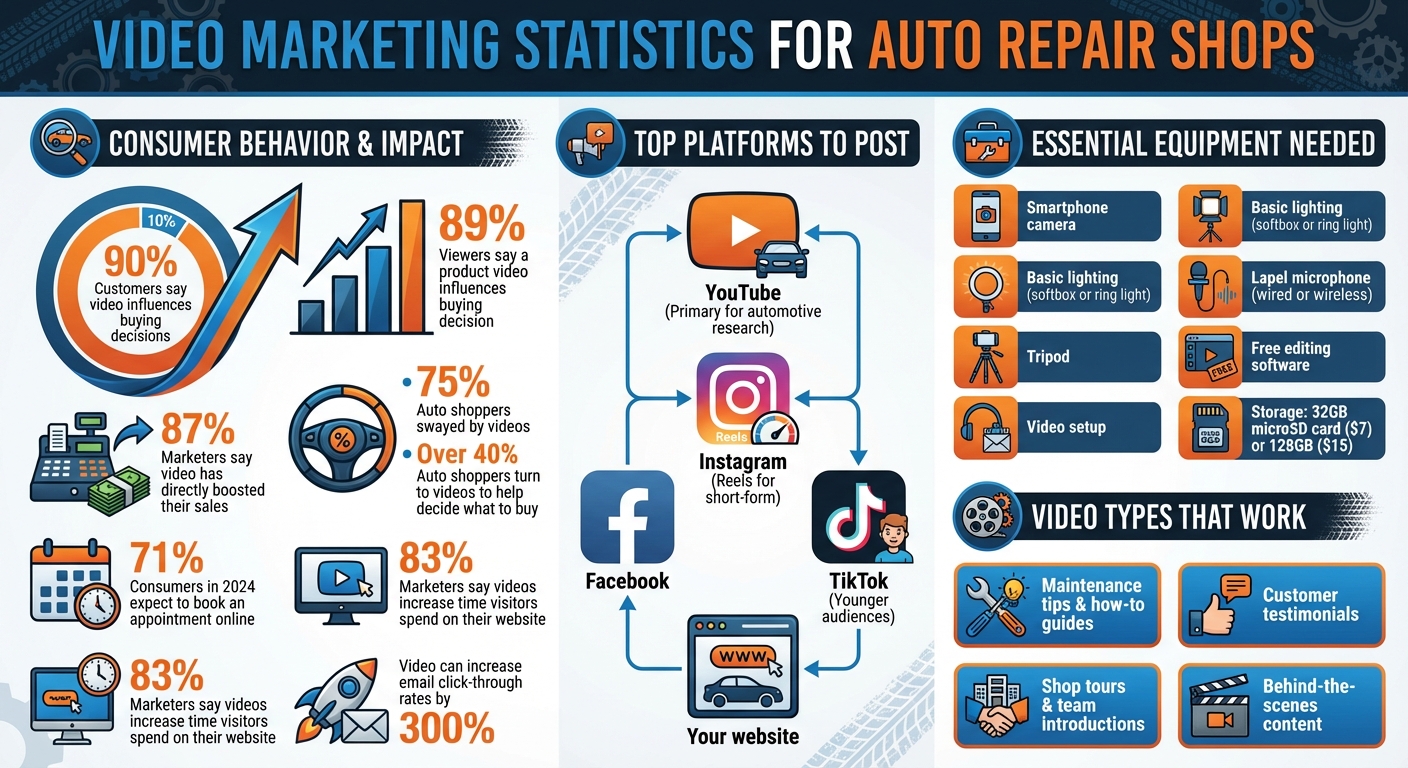
Video Marketing Statistics for Auto Repair Shops
Planning Your Video Marketing Strategy
Setting Your Goals
Start by defining clear goals for your video marketing efforts. Whether you’re aiming to increase visibility, establish trust through transparency, or position yourself as an expert, having specific objectives is key. For example, you might focus on attracting new customers to your service bays or creating educational content, like maintenance tips and how-to guides, to become a go-to resource. Other priorities could include showcasing your service quality, improving SEO, or driving appointment bookings.
The stats speak for themselves: 87% of marketers say video has directly boosted their sales, and adding video can increase email click-through rates by 300%. To make your goals actionable, apply the SMART framework – Specific, Measurable, Achievable, Relevant, and Time-bound. Instead of a vague aim like "get more customers", set a measurable target like "generate 15 new appointment requests from YouTube videos within three months." Align your goals with metrics: track views for awareness, likes and shares for engagement, and appointments for lead generation.
Knowing Your Audience
Understanding your audience is crucial to creating content that connects. Start by analyzing your existing customer data to identify trends among your most loyal and profitable customers. Look at factors like age, income, vehicle types, and the services they frequently need. For example, a California shop discovered that 20% of its customers accounted for 80% of its sales – primarily middle-class homeowners with specific vehicle preferences.
Segment your audience into groups based on shared traits, such as "young professionals with sports cars" or "families with multiple vehicles". Research local demographics to identify the dominant customer groups in your area. Dive deeper by identifying their concerns – are they worried about maintenance costs, looking for quick solutions, or struggling to find a trustworthy shop after bad experiences?. You can gather this information through simple conversations or surveys. Ask questions like, "What made you choose our services?" or "Do you visit for preventative maintenance or only when issues arise?". These insights will guide you in selecting video topics that resonate with your audience.
Once you have a clear picture of who you’re targeting, you can move on to choosing the right video formats that align with your goals and budget.
Selecting Video Types and Setting a Budget
With your goals and audience in mind, it’s time to pick the video formats that best suit your needs. Educational videos, like maintenance tips or diagnostic guides, are a great way to build trust and showcase expertise without requiring a big production budget. Behind-the-scenes content can highlight your team’s personality and add a layer of transparency, while customer testimonials provide the social proof that helps influence decisions. Short-form videos are another cost-effective option, offering a quick way to showcase your shop’s character and generate leads.
You don’t need a huge budget to get started. A simple setup – a smartphone, basic lighting, and free editing tools – can deliver professional-looking results. As Kieran O’Brien, Co-Founder & CEO of Shopgenie, explains:
"We’re seeing a massive shift in consumer behavior. Consumers are used to making restaurant reservations, doctors appointments, and everything else online, so naturally they will gravitate towards a shop that provides a familiar experience. Over 71% of consumers in 2024 expect to book an appointment online".
Allocate your budget based on your priorities. If your focus is on building trust, invest in testimonial videos and shop tours. If education is your main goal, create a library of how-to videos. Monitor what resonates with your audience and adjust your spending to amplify what works best.
The Content Marketing Strategy for Auto Repair Shops: Creating Engaging and Educational Content
Types of Videos That Work for Auto Shops
When you know your audience and have clear goals in mind, the next step is choosing the right kinds of videos to highlight what makes your shop stand out.
Maintenance Tips and How-To Videos
Educational videos are a powerful way to break down complicated automotive topics into simple, easy-to-digest content. Did you know that over 40% of auto shoppers turn to videos to help them decide what to buy? Google even prioritizes "how-to" videos in search results because people love step-by-step visual guides for everyday problems.
These videos work because they show, not just tell. For example, a video that walks viewers through an oil change – pointing out the oil plug’s location and explaining each step – can make a big impact. This kind of guidance not only helps viewers but also establishes your shop as a reliable source of knowledge. Barry Alt from Motorhead Digital puts it perfectly:
"By using video in this detailed way you’ll be able to draw more customers in by providing consumable, helpful content".
Start with "pillar videos" that tackle common maintenance tasks, like changing oil or checking for a flat tire. The goal is to provide free, practical advice that builds trust and shows your shop’s expertise. Brian Walker, Owner of Shop Marketing Pros, adds:
"Every car that comes in can be an endless source of content".
Once you’ve built credibility with educational content, customer stories can take things a step further.
Customer Testimonials and Success Stories
Nothing builds trust like hearing from satisfied customers. Testimonials give your shop social proof, showing potential clients that others have had great experiences with you. 89% of viewers say a product video influences their buying decision, and videos sway 75% of auto shoppers. Authentic reviews help ease doubts and build confidence.
A great example is Volkswagen UK‘s #YourWagen campaign. They created short, 1- to 2-minute YouTube videos featuring real customer stories. Because these testimonials were collected naturally, they felt genuine and relatable.
When a happy customer shares their experience, ask if they’d be open to recording a quick video. Prepare a few standard questions to make the process smooth and get honest, heartfelt responses.
In addition to testimonials, showing the people behind your business can make your shop even more approachable.
Shop Tours and Team Introductions
Behind-the-scenes videos are a fantastic way to introduce your team and give potential customers a feel for your shop. These videos create a personal connection, which can make someone more likely to choose you over a competitor. Plus, 83% of marketers say videos increase the time visitors spend on their website.
Use these videos to showcase your shop’s personality. Introduce yourself and your team members, walk viewers through your facilities, and highlight the tools and equipment you use. Barry Alt from Motorhead Digital explains:
"The closer your audience feels to you the easier it will be to get them to convert to paying customers".
You can also show snippets of daily life at the shop – like team celebrations, hobbies, or the process of prepping a car for pickup. Even small moments, like unpacking new parts, can give viewers a sense of what it’s like to work with you. This kind of transparency builds trust and makes customers feel like they already know you.
sbb-itb-02fe772
Creating Quality Videos Without Overspending
You don’t need a massive budget to produce professional-looking videos. With a clear strategy in place, focus on affordable tools and smart choices to get the job done. The secret lies in using the right equipment and making the most of your recording environment.
Equipment You’ll Need
Start with what you already have: your smartphone. Most modern phones can record excellent video, making them a practical and budget-friendly option. Before investing in additional gear, test your phone’s built-in microphone to see if it delivers clear audio without picking up too much background noise.
If the audio quality isn’t up to par, consider upgrading to a wired or wireless lapel microphone. Crisp, clear sound can instantly elevate the professionalism of your videos. For lighting, natural light from windows or existing lamps is a great starting point. However, adding a softbox or ring light can help create a more polished look. Affordable lighting kits are widely available and easy to use. To avoid shaky footage, invest in a tripod – a simple but essential tool that makes a big difference in video quality.
For storage, a 128GB microSD card costs around $15, while a 32GB card is about $7 at Walmart, providing plenty of space for your video files.
Once you have your equipment, it’s time to set up a recording space that works for you.
Setting Up Your Recording Space
You don’t need a fancy studio to create great videos. A simple, well-organized space can work wonders. Even a quiet corner of your home or office can serve as a professional backdrop with a bit of effort.
For a temporary setup, choose a quiet area with minimal background noise. Film against a clean wall or a simple backdrop, and schedule your recording sessions to avoid interruptions. Portable lighting options, like softboxes or ring lights, can help you achieve consistent results without requiring a permanent setup. Pair this with a lapel microphone for better audio clarity.
If you’re ready to take things up a notch, dedicate a small area specifically for filming. Decorate it with brand colors, subtle signage, or tasteful decor to give your videos a consistent and polished look.
Editing and Storing Your Videos
Once your footage is ready, editing is where the magic happens. Thankfully, you don’t need expensive software to create professional results. There are plenty of affordable tools that can help you polish your videos on a budget.
AI-powered editing tools are becoming increasingly popular, offering features like automated workflows and handling repetitive tasks. These tools can save you time by organizing footage, tagging clips, and even removing unusable shots, like those that are shaky or out of focus.
To keep your video library organized, use cloud storage and file transfer services. These tools can help you manage your files efficiently, making it easy to access and share your content whenever you need it.
Publishing Videos and Tracking Results
Once your videos are edited and ready to go, share them where your audience spends their time. YouTube is a powerhouse for automotive research – especially for test drives and learning about new vehicles – making it the go-to platform for hosting longer videos and boosting your search visibility. Upload content like maintenance tips, shop tours, and detailed how-to guides to attract viewers actively searching for solutions.
Don’t stop there – repurpose your content for key social platforms. Short-form videos work wonders, especially for reaching younger audiences and keeping your business top-of-mind with loyal customers. Tailor your videos to suit the strengths of each platform.
Uploading to Different Platforms
Start with YouTube as your central hub for videos. Optimize your uploads with descriptive titles, clear descriptions, and relevant tags to improve discoverability. From there, trim longer videos into 15–60-second clips for Instagram Reels and TikTok, highlighting the most engaging moments. Facebook is ideal for slightly longer videos, while YouTube Shorts can grab viewers looking for quick tips.
On your website, embed videos strategically – place them on service pages, your homepage, or even in a dedicated section for customer testimonials.
Measuring Video Performance
After publishing, it’s time to see how your videos are performing. Keep an eye on key metrics across platforms. Remember, platforms measure views differently – Facebook counts a view after just 3 seconds, while YouTube requires 30 seconds or the full video for shorter clips. Focus on metrics like watch time, click-through rates, and engagement (comments and shares) to understand what’s working.
It’s also important to connect video performance to your business goals. While videos often build awareness rather than driving immediate sales, they play a crucial role in the longer automotive customer journey, which can take weeks or months. Track calls from video platforms, appointments booked after watching, and how many viewers turn into paying customers.
Adjusting Your Strategy Based on Data
Review your performance metrics weekly to catch trends early. Track calls from YouTube and social media, appointments booked through video content, show rates, repair order percentages, average repair values, and the ratio of new to repeat customers. Don’t forget to monitor online reviews and their average ratings. If your videos are racking up views but not translating into bookings, the issue might lie in the next step of your customer journey.
Refine your approach based on what the data tells you. If how-to videos are outperforming shop tours, focus on producing more how-to content. If Instagram Reels are getting more traction than Facebook posts, shift your energy to Instagram. Pay attention to customer feedback in comments and direct messages to better understand what resonates with your audience. Regularly fine-tuning your video strategy ensures that your efforts stay aligned with your overall marketing goals. Small, data-driven adjustments can keep your momentum going and help bring more customers through your doors.
Conclusion
Main Points to Remember
Video marketing can give auto repair shops a real edge in today’s competitive digital landscape. To succeed, start with a plan: define your goals, identify your target audience, and choose video types that highlight what your shop does best. Whether it’s sharing maintenance tips, showcasing customer testimonials, or giving viewers a behind-the-scenes look at your shop, aim for authenticity over perfection. You don’t need a fancy camera setup – smartphones and basic lighting can produce great results.
Consistency beats high production value. Regularly share your videos on platforms like YouTube, Instagram, and Facebook, and track their performance. Focus on metrics like watch time, engagement, and, most importantly, how many viewers turn into paying customers. Use this data to fine-tune your strategy. For example, if how-to videos generate more calls, double down on creating similar content. Over time, video marketing can build your shop’s visibility, keeping your business top of mind when customers are ready to book an appointment.
A well-thought-out video strategy not only builds trust but also positions your shop as a dependable, community-focused business. By applying these principles – and seeking expert guidance when needed – you can turn casual viewers into loyal customers.
How Auto Repair Leads Pro Can Help
If you’re ready to take your video marketing to the next level, expert support can make all the difference. Auto Repair Leads Pro specializes in helping auto repair shops craft comprehensive marketing strategies that seamlessly integrate video content with other key elements like website development, SEO, and targeted advertising.
When your videos work hand-in-hand with optimized service pages and strong local search visibility, you create a powerful system that guides potential customers from their initial search to booking an appointment. Auto Repair Leads Pro’s tailored approach ensures your videos not only increase visibility but drive real results, allowing you to focus on what you do best – running your shop.
FAQs
How does video marketing help build trust with customers at my auto shop?
Video marketing is a powerful way to build trust by showing a more personal and transparent side of your auto shop. It gives you the chance to highlight your team’s skills, showcase your services, and even share behind-the-scenes glimpses of your daily operations. This approach makes your business feel more relatable and assures potential customers that they’re working with skilled, dependable professionals.
You can also use videos to emphasize your dedication to quality and customer care. Whether it’s through customer testimonials, repair tutorials, or step-by-step service walkthroughs, these videos can boost your shop’s credibility. They help create genuine connections with your audience, increasing the likelihood that they’ll choose your shop for their automotive needs.
What are the best platforms to share auto shop videos for maximum visibility?
To get the most out of your auto shop videos, it’s all about choosing the right platforms. YouTube is perfect for longer, detailed content where you can dive into repairs, maintenance tips, or behind-the-scenes footage. For shorter, more engaging clips, Facebook and Instagram are great options, especially for stories and quick updates. Don’t overlook TikTok – its fast-paced, creative vibe is ideal for short, eye-catching videos that can quickly grab attention. Plus, Instagram Reels offer another way to reach a wider audience with dynamic and shareable content. By tailoring your videos to fit each platform, you can effectively showcase your auto shop and draw in new customers.
What budget-friendly tools can I use to start video marketing for my auto repair shop?
Starting video marketing for your auto repair shop doesn’t mean spending a fortune. You can get started with just a smartphone for filming, a DJI Mic to ensure clear audio, and magnetic mounts to keep your shots steady. When it comes to editing, Canva (starting at $14.99/month) and CapCut (around $25.99/month) are simple yet powerful tools that make the process easy, even for beginners. To host and share your videos, platforms like Vidyard offer free basic plans, giving you an affordable way to reach your audience. These budget-friendly tools are all you need to start creating videos that connect with your customers and bring in more business.