Customer journey analytics helps businesses understand every interaction a customer has with them – from the first search to post-service follow-ups. For auto repair shops, this means identifying where customers face issues, like abandoned bookings or long wait times, and improving those areas. By tracking key metrics like booking rates, repair times, and customer satisfaction scores, shops can make data-driven decisions that boost loyalty and revenue.
Key Takeaways:
- Why It Matters: 71% of consumers prefer online booking, and 60% rely on professional websites when choosing mechanics. Analytics helps auto repair shops track and improve these touchpoints.
- Steps to Success: Map the customer journey through eight stages (Awareness to Retention), track metrics like Net Promoter Score (NPS) and appointment rates, and use tools like Google Analytics and CRM systems.
- Results: Shops that optimize their customer journey can see up to a 25% increase in bookings, a 20% improvement in satisfaction, and reduced service costs.
The guide provides actionable steps to refine every stage of the customer journey using analytics, from improving online booking tools to better follow-up strategies. By focusing on customer needs and data, auto repair shops can drive growth and build lasting relationships.
Measuring Your Customer Journey Performance – Keith Kmett of Medallia
Mapping the Auto Repair Customer Journey
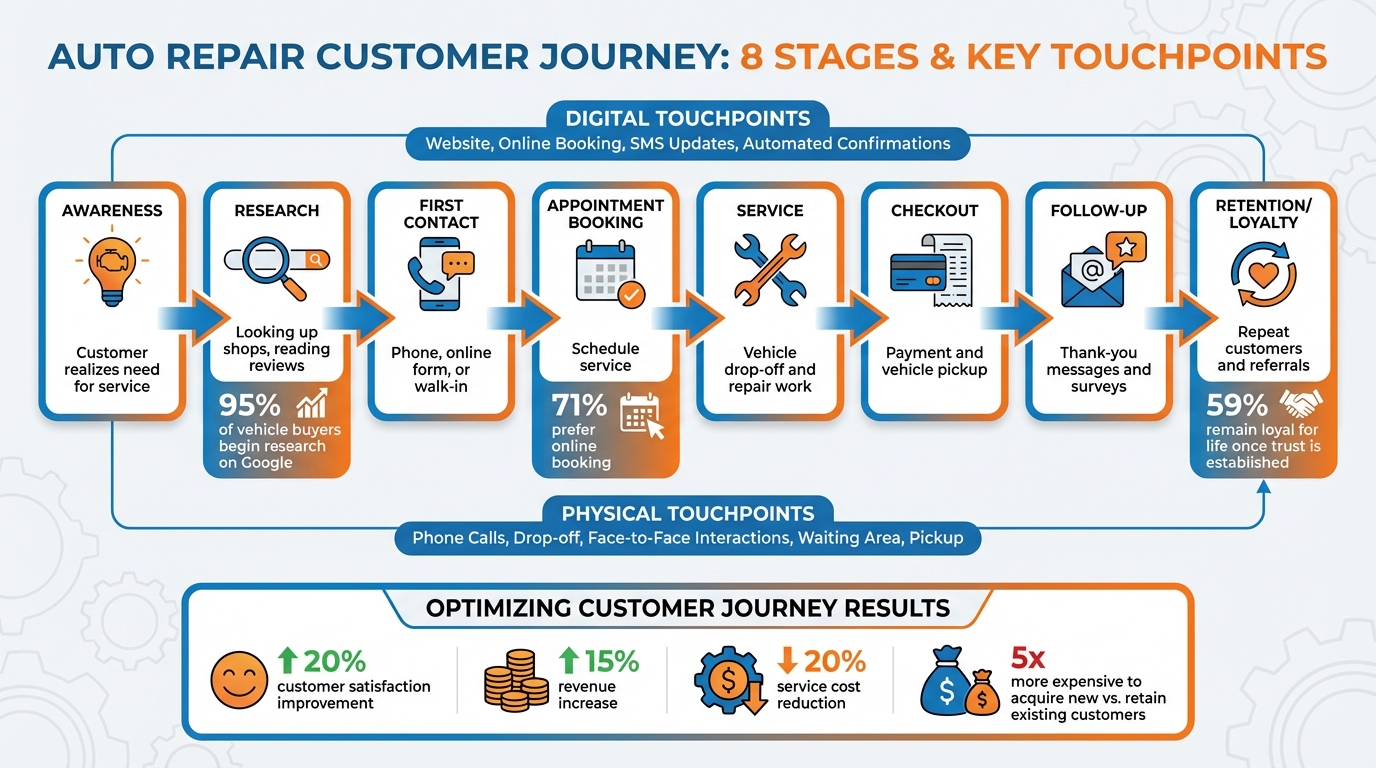
8-Stage Auto Repair Customer Journey Map with Key Metrics
The Main Stages of the Customer Journey
The typical auto repair customer journey unfolds across eight key stages: Awareness, Research, First Contact, Appointment Booking, Service, Checkout, Follow-up, and Retention/Loyalty. Each step offers an opportunity to either solidify or weaken your relationship with the customer.
Awareness begins when a customer realizes they need auto service – maybe their check engine light turns on, or it’s time for routine maintenance like an oil change. Research follows, where they look up shops on Google, read reviews, and compare options. During First Contact, they may reach out via phone, online forms, or by walking into your shop. Appointment Booking is the stage where they schedule their service, often influenced by the ease of your booking process. The Service stage covers everything from dropping off their vehicle to the repair work itself, including updates on the progress. Checkout involves payment and picking up the vehicle. Follow-up includes actions like sending thank-you messages or surveys to gather feedback. Finally, Retention/Loyalty is about keeping satisfied customers coming back and encouraging them to recommend your shop to others.
Why does understanding this journey matter? Because improving the customer experience at every stage can lead to some impressive results: it can boost customer satisfaction by 20%, increase revenue by 15%, and reduce service costs by up to 20%. Plus, keeping a customer is far more cost-effective – it’s up to five times more expensive to attract a new customer than to retain an existing one. That’s why focusing on retention is a smart move for your business.
Digital and Physical Touchpoints
Each stage of the journey involves both digital and physical touchpoints where customers interact with your business. Digital touchpoints include Google searches (where a staggering 95% of vehicle buyers begin their research), your website, online booking tools, automated appointment confirmations, and SMS updates on repair status. On the other hand, physical touchpoints include phone conversations, vehicle drop-offs, face-to-face interactions with advisors, the waiting area, checkout, and vehicle pickup.
Some moments stand out as particularly critical, like booking appointments and picking up the vehicle. For instance, one auto repair shop that streamlined its online booking system and added real-time availability updates saw a 25% drop in booking abandonment and a 22% rise in completed bookings. Another shop introduced automated SMS updates to keep customers informed about repair progress. This simple change led to an 18% jump in customer satisfaction and a 12% increase in repeat visits. These examples highlight how thoughtful improvements can ease customer anxiety and build trust.
Different Journeys for Different Customers
Not all customer journeys are the same. A first-time customer searching for a reliable shop has very different needs compared to a loyal customer who already trusts your services. Similarly, someone dealing with an emergency repair after a breakdown will have a completely different experience than someone scheduling routine maintenance. The former needs immediate assistance and clear communication, while the latter prioritizes convenience and efficiency.
To better serve these varied needs, it’s helpful to create 3-5 customer personas based on real data. For example, a "Busy Professional" persona might value fast online booking, minimal wait times, and frequent digital updates throughout the process. Their journey would focus heavily on digital touchpoints and streamlined service. In contrast, an older customer who prefers phone calls and face-to-face communication would require a more personal, hands-on approach.
Mapping these distinct journeys allows you to identify potential pain points for each customer type. For instance, a loyal customer might be willing to overlook minor delays, but a first-time customer facing the same issue could leave a negative review and never return. Since 59% of American consumers say they remain loyal to a brand for life once trust is established, understanding these nuances is crucial. Tailoring your approach to meet the unique needs of each customer type can help you refine every stage of their experience and build stronger, lasting relationships.
Key Metrics and Data Sources for Auto Repair Businesses
Once you’ve mapped out the customer journey, tracking the right metrics becomes essential to refining every interaction and driving growth. Much of the data you need is already available – you just need to pinpoint and monitor the key indicators. Below, you’ll see how marketing, conversion, and retention metrics work together to provide a full view of your customer journey.
Marketing and Lead Generation Metrics
Marketing metrics help you understand how effectively you’re attracting potential customers. Start with impressions (how many people see your ads), clicks (how many engage with them), and cost per lead (what you’re spending to acquire each potential customer). You can gather this data from tools like Google Ads, Facebook Ads Manager, and Google Business Profile insights.
One of the most critical metrics for auto repair shops is phone calls. These often represent your most valuable leads, as they tend to convert faster and result in more loyal customers compared to web-only inquiries. Call tracking tools can reveal which marketing channels drive those calls. Without tracking this data, you miss out on crucial insights. To get the full picture, integrate call tracking data with your CRM, allowing you to follow the customer journey from the initial call to the completed service.
Conversion and Revenue Metrics
Conversion metrics show how well you’re turning interest into business. Key metrics to track include your appointment booking rate (the percentage of inquiries that result in scheduled appointments), average repair order (ARO), and revenue per marketing channel. These figures are typically available in your shop management system, CRM, or website analytics.
Research shows that customer-focused businesses are 60% more profitable, and 86% of customers are willing to pay more for a great experience. By optimizing your customer journey using these metrics, you can achieve tangible results like a 15–25% boost in booking conversion rates, a 20–35% reduction in vehicle pickup wait times, and a 10–20 point increase in customer satisfaction scores. Regularly reviewing reports can help you spot trends, such as which marketing channels generate the highest ARO or where customers drop off during the booking process.
While conversion metrics focus on turning interest into revenue, retention metrics help you evaluate long-term customer loyalty.
Customer Satisfaction and Retention Metrics
Retention and satisfaction metrics reveal whether customers will return and recommend your services. Two key indicators to monitor are Net Promoter Score (NPS), which measures the likelihood of referrals, and Customer Satisfaction Score (CSAT), which gauges overall satisfaction with their experience. Additionally, tracking repeat visit frequency and customer lifetime value can provide valuable insights into loyalty and help you prioritize areas for improvement.
According to the J.D. Power 2025 U.S. Customer Service Index Study, 12% of repairs aren’t completed correctly on the first visit. Among these customers, only 50% returned or planned to return. This highlights a major retention challenge. To gather this data, use post-service surveys (tools like Zigpoll start at $500/month), your CRM’s customer history, and online review platforms. Identifying patterns – such as frequent complaints about communication – pinpoints exactly where to focus improvement efforts, such as investing in staff training.
Tools and Technologies for Customer Journey Analytics
Once you’ve got a handle on customer journey mapping and the metrics that matter, the next step is leveraging the right tools to turn data into actionable insights. A well-organized tech stack makes it easier to track customer interactions and uncover patterns at key points in their journey. Many auto repair shops already use some of these tools – it’s just a matter of knowing how to make the most of them. Let’s dive into how website analytics, CRM systems, and feedback tools can provide a clearer picture of your customers’ experiences.
Website Analytics Platforms
Google Analytics 4 is the go-to tool for understanding how customers navigate your website. It’s free and tracks everything from page views to where users drop off, like in your online booking process. For example, if you notice a high abandonment rate on the payment page, this could signal a technical glitch or a lack of trust from your customers. For larger shops with more complex needs, Google Analytics 360 offers enterprise-level features, starting at $50,000 per year.
These platforms do more than just track traffic. They help identify which marketing channels deliver the most valuable customers. For instance, you can compare whether visitors from Google Ads book more appointments than those from social media, allowing you to fine-tune your marketing spend. You can also use insights about how long customers spend researching your services to refine your content strategy. When paired with CRM systems, web analytics can provide a more complete view of customer behavior across multiple touchpoints.
CRM and Shop Management Systems
CRM and shop management systems are essential for organizing customer data. They centralize information like service history, appointment schedules, and communication records, while automating tasks such as appointment confirmations, service reminders, and follow-ups. This reduces manual work and keeps everything running smoothly.
When integrated with website analytics and call tracking tools, these systems create detailed customer profiles. They can include vehicle information, past interactions, and even flag customers who might be at risk of leaving, so you can launch proactive win-back campaigns. This level of integration ensures that every interaction – whether online, over the phone, or in person – feeds into a unified customer journey.
Survey, Feedback, and Call Tracking Tools
Customer feedback adds an important layer to behavioral data. Tools like SurveySensum (starting at $299 per month) and Zonka Feedback (starting at $49 per month) make it easy to deploy NPS and CSAT surveys at critical moments, such as after a booking, service completion, or vehicle pickup. Sending SMS surveys within 24 hours of service completion can help you capture fresh and relevant feedback. Using multiple channels – email, SMS, or even QR codes on receipts – can boost response rates.
For auto repair shops, call tracking tools are especially valuable since phone calls often generate high-quality leads. These tools can help you identify which marketing channels drive calls, track missed call rates, and even record calls for quality assurance. When linked to your CRM, call tracking data ties phone interactions to completed services, giving you a clearer picture of your phone leads’ ROI. Platforms like BOLT ON Technology take it a step further by automating review requests and managing customer feedback. Some tools even use AI-driven sentiment analysis to uncover recurring themes in customer reviews, offering deeper insights into customer satisfaction.
sbb-itb-02fe772
Using Analytics to Improve the Customer Journey
Once you’ve gathered data, the next step is to turn those insights into actionable strategies that improve each stage of your customer journey. The goal is to tackle specific challenges at every phase and make data-driven adjustments that enhance the overall experience. Here’s how analytics can help refine the awareness, booking, and service stages of the process.
Improving Awareness and Research Stages
The way customers shop for cars has shifted dramatically, with 43% of car buyers relying on digital channels during the consideration phase in the past two years – a 9% increase compared to earlier periods. This growing dependence on digital research means your online presence is crucial during the awareness and research stages. It can either draw in new customers or cause you to lose them to competitors.
Start by diving into your traffic sources using tools like Google Analytics 4 to understand where your website visitors are coming from. If organic search is your top driver, focus on improving your SEO. For example, optimize service pages with local keywords such as "brake repair near me" or "oil change in [your city]." If paid ads are performing well, invest more in those campaigns. Keep an eye on engagement metrics like time on page and bounce rate – if visitors leave quickly, it could mean your content isn’t meeting their needs or answering their questions effectively.
Since 45% of buyers want to feel very certain a vehicle is the right fit before contacting a dealer, it’s clear they’re conducting deep research online. Ensure your website offers detailed service descriptions, transparent pricing, and customer reviews. Use analytics to track which pages get the most views and longest engagement times, then build more content around those topics. For instance, if your "transmission repair" page gets high traffic but low conversions, consider adding educational resources, before-and-after photos, or video walkthroughs to build trust and credibility.
By strengthening your online presence, you’re setting the stage for smoother interactions when customers move to the booking phase.
Better First Contact and Booking Processes
The first interaction a potential customer has with your business – whether through a phone call, online form, or booking tool – is a make-or-break moment. Analytics can help you pinpoint where prospects drop off in the process. For example, monitor your booking conversion rates in website analytics. If customers start but don’t complete the booking process, look for issues like complicated forms, limited time slot availability, or unclear pricing information.
Call tracking tools are another valuable resource. They can show which marketing channels lead to calls and help you analyze call-to-appointment conversion rates. If a significant number of calls don’t result in bookings, review call recordings to identify problems like long hold times or ineffective responses to customer objections. AI-powered tools can even flag calls where bookings weren’t made and capture useful insights like caller preferences or missed opportunities.
For online forms, connect submissions to your CRM and track the form-to-appointment rate. A low rate might mean your follow-up process is too slow. In fact, 62%-65% of customers now expect quick, real-time responses from automotive service providers. To meet these expectations, integrate real-time automated confirmations and ensure follow-ups happen within an hour during business hours.
Once a booking is secured, analytics can continue to refine the service, checkout, and follow-up stages.
Better Service, Checkout, and Follow-Up
Analytics doesn’t end when a customer books an appointment. Use it to track service cycle times – how long repairs take compared to estimates – and on-time delivery rates. Identifying delays and operational bottlenecks helps you improve efficiency and customer satisfaction.
Your CRM can also automate follow-up reminders based on service history. For example, if a customer had an oil change in March, schedule a reminder for September via email or SMS. Measure the response rates to these reminders and experiment with different messaging to see what resonates most with your audience.
Send automated NPS or CSAT surveys within 24 hours of service to gather timely feedback tied to specific transactions. Monitor these scores over time to spot trends. If certain technicians consistently receive lower ratings, use this data to provide targeted coaching. Additionally, connect survey feedback to individual transactions in your CRM so you can personally reach out to dissatisfied customers and turn negative experiences into opportunities to rebuild trust.
Continuous Improvement Through Analytics
Analytics isn’t a one-and-done task – it’s an ongoing process that demands regular adjustments. The most effective auto repair shops approach their customer journey strategies as living, evolving plans, tweaking them daily or weekly based on actual performance rather than setting them in stone. Customer expectations shift, new technologies emerge, and competition intensifies. To stay ahead, you need to build adaptability and constant learning into your operations. This cycle of refinement strengthens every stage of the customer journey.
Creating a Test-and-Learn Process
Once you’ve gathered insights into your customer journey, the next step is to establish a test-and-learn approach. Use data from surveys, website analytics, and CRM tools to pinpoint problem areas. For every issue you uncover, implement a testable solution and evaluate its impact.
Take this real-world example: An auto repair shop discovered that 40% of potential customers abandoned their booking process. By simplifying the interface and adding real-time updates on availability, they reduced abandonment to 15% and saw a 22% increase in overall bookings.
A/B testing tools can help you validate these changes before fully rolling them out. Track both customer-focused metrics – like Net Promoter Score (NPS) and Customer Satisfaction (CSAT) – and operational metrics such as conversion rates and cycle times. This dual approach ensures that your updates improve not only the customer experience but also your bottom line. Regularly review and update your customer journey maps, ideally every quarter or after implementing major changes, to keep them aligned with actual customer experiences.
Prioritizing Improvements
Not every issue needs immediate attention. Focus on quick wins – those high-impact changes that require minimal effort but deliver noticeable results. Prioritize areas that affect your largest or most valuable customer segments, especially frequent friction points.
Critical touchpoints like booking and vehicle pickup often have the greatest influence on customer satisfaction and conversion rates. Addressing these areas can lead to significant improvements with minimal investment.
Every improvement should align with your business goals. For instance, if reducing churn is a priority, focus on retention strategies and follow-up processes. If revenue growth is your target, optimize key conversion points in your booking funnel. Balancing short-term gains with long-term customer satisfaction is a challenge for over 60% of marketing leaders, so ensure your priorities address both. Remember, 94% of customers are more likely to return after a positive service experience, making customer journey improvements a direct driver of revenue. As mentioned earlier, measuring conversion rates and customer feedback is essential – continuous improvement builds on these insights.
How Auto Repair Leads Pro Uses Analytics
This iterative approach is exactly how industry leaders leverage analytics. Auto Repair Leads Pro empowers auto repair businesses to improve continuously by using advanced analytics. By tracking website activity, lead generation, and conversion rates across SEO and PPC campaigns, they pinpoint where potential customers drop off and identify the changes that will have the biggest impact.
Their tailored marketing strategies combine real-time analytics with customer-focused campaign design. This ensures improvements are guided by actual customer behavior, not assumptions. Whether it’s streamlining a booking funnel, boosting local SEO rankings, or refining PPC ad targeting, Auto Repair Leads Pro helps shops optimize their customer acquisition and retention efforts. With this data-driven approach, your marketing strategies stay effective and constantly improve.
Conclusion: Growing Your Business Through Customer Journey Analytics
Customer journey analytics isn’t just about crunching numbers – it’s about uncovering insights that can transform every stage of your business. By carefully mapping out touchpoints, focusing on the right metrics, and refining your strategies, you can create experiences that keep customers coming back. In fact, studies show that 94% of customers are likely to make repeat purchases after a positive service experience. Every improvement you implement directly contributes to your bottom line.
As highlighted in this guide, successful auto repair shops don’t treat analytics as a one-and-done task. Instead, they view it as an ongoing process, constantly learning and adapting. These shops gather data from every customer interaction, pinpoint areas of friction, test new solutions, and measure the results. Whether it’s cutting down booking abandonment rates, streamlining vehicle pickup times, or enhancing communication during repairs, each improvement builds upon the last.
To see meaningful results, focus on the areas that matter most – like simplifying your booking process, keeping customers informed with service updates, and optimizing the checkout experience. Use the tools and strategies outlined here to gather feedback, understand customer behavior, and prioritize the changes that will make the biggest impact.
Once you’ve built a strong foundation, consider bringing in expert support to take things further. Auto Repair Leads Pro offers advanced analytics to track website activity, lead generation, and conversion rates across your marketing channels. They help pinpoint where potential customers drop off and provide tailored SEO and PPC strategies, all backed by real-time data. From the first click to repeat visits, they can help you optimize every stage of the customer journey.
The businesses that thrive today are the ones that pay attention to their data and act swiftly. Your analytics don’t just show where you are – they guide you toward where you need to go. Start making data-driven decisions now to streamline operations, increase customer loyalty, and boost your profits.
FAQs
How does customer journey analytics enhance customer satisfaction for auto repair shops?
Customer journey analytics can play a key role in helping auto repair shops boost customer satisfaction by shedding light on what customers truly want and expect. By analyzing how customers engage with your business, you can better anticipate their concerns, communicate more effectively, and deliver a tailored experience.
This strategy helps build trust by making repair timelines, costs, and processes more transparent. It also minimizes uncertainty, ensuring customers feel informed and confident throughout their interaction. The end result? A smoother, more positive experience that encourages loyalty and long-term satisfaction.
What key metrics should auto repair businesses track to improve the customer journey?
Tracking the right metrics is crucial for refining the customer experience in the auto repair business. Here are some key ones to keep an eye on:
- Net Promoter Score (NPS): This tells you how loyal your customers are and how likely they are to recommend your shop to others.
- Customer Satisfaction (CSAT): A straightforward way to gauge how happy customers are with their overall experience.
- Booking Abandonment Rates: Helps you see how often customers start scheduling a service but don’t follow through.
- Average Wait Times: Measures how long customers wait during service drop-off or pickup, giving insight into operational efficiency.
- Repeat Customer Rates: Tracks how many of your customers come back for more services, a strong indicator of trust and satisfaction.
Digging into these metrics can help pinpoint problem areas and fine-tune your operations for a smoother, more enjoyable customer journey.
How do online and in-person interactions shape the customer experience in auto repair services?
Digital tools, such as online booking systems and real-time updates, provide ease and customization, streamlining the experience for customers. Meanwhile, in-person interactions – like face-to-face consultations and hands-on assistance – play a key role in building trust and delivering a dependable service.
When combined, these touchpoints create a smooth and satisfying journey that strengthens customer loyalty in auto repair services.