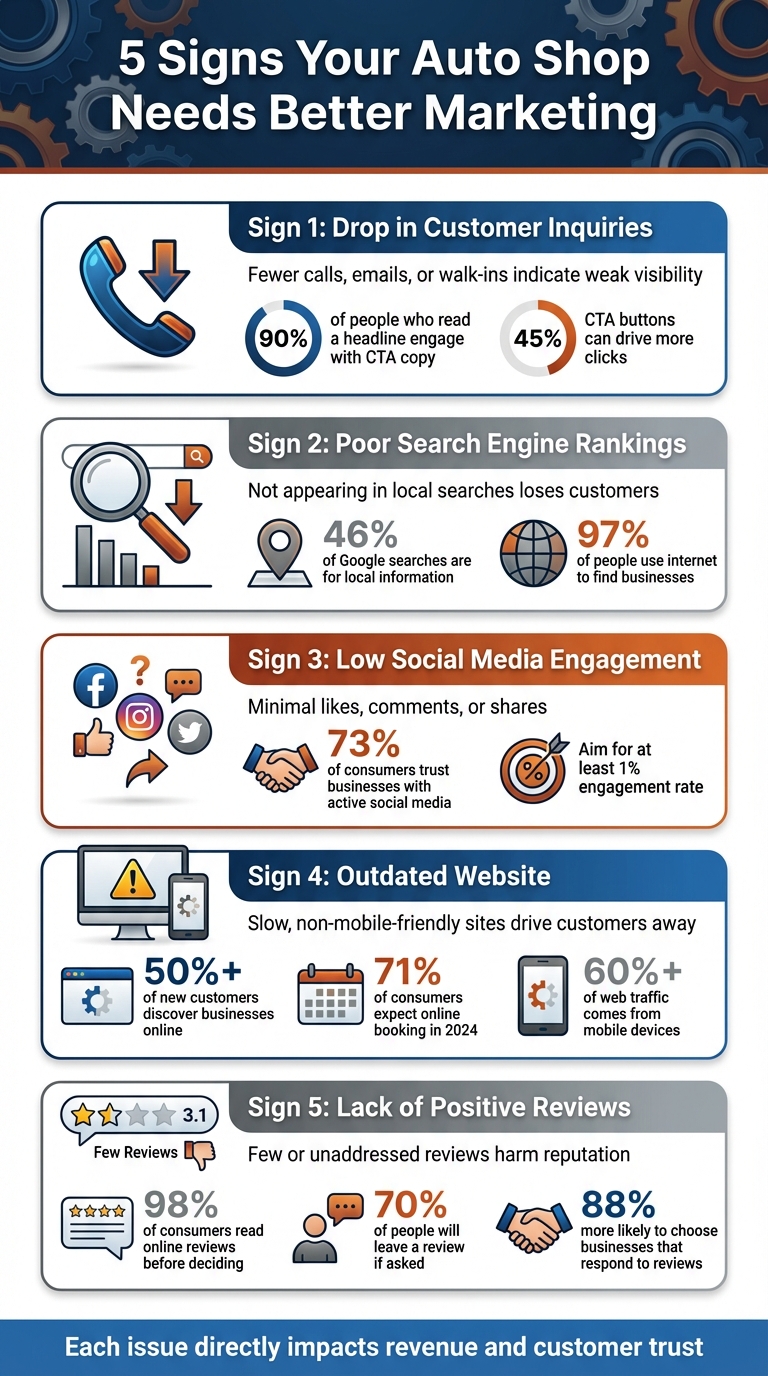
If your auto shop is struggling to attract and retain customers, poor marketing could be the reason. Here are five clear signs your marketing needs improvement:
- Drop in Customer Inquiries: Fewer calls, emails, or walk-ins indicate weak visibility and ineffective calls-to-action.
- Poor Search Engine Rankings: If your shop doesn’t appear in local searches, potential customers won’t find you online.
- Low Social Media Engagement: Minimal likes, comments, or shares suggest your content isn’t resonating with your audience.
- Outdated Website: Slow-loading, non-mobile-friendly websites with missing features like online booking drive customers away.
- Lack of Positive Reviews: Few or unaddressed reviews can harm your reputation and discourage potential clients.
Each of these issues directly impacts your revenue and customer trust. Fixing them can help your shop stand out in a competitive market.
5 Signs Your Auto Shop Needs Better Marketing
How Can I Market My Auto Repair Shop?
Sign 1: Fewer Customer Inquiries
If your phone isn’t ringing as often and your inbox is unusually quiet, it’s a strong sign that your marketing efforts might not be hitting the mark. A noticeable drop in customer inquiries – whether through calls, online forms, or even walk-ins – points to a gap in your strategy that needs fixing.
How to Spot the Problem
Take a closer look at your inquiry trends over the past 3–6 months. Are you seeing fewer phone calls, fewer website form submissions, or less foot traffic? These dips often highlight a decline in your local visibility.
One common issue many auto shops face is weak or missing calls-to-action (CTAs) in their marketing materials. CTAs are crucial – about 90% of people who read a headline also engage with the CTA copy. Without clear prompts like “Call now for a free brake inspection” or “Schedule your oil change online today,” you’re likely leaving business on the table. Even small tweaks can make a big difference. For example, experimenting with CTA buttons can drive 45% more clicks, while incorporating anchor text CTAs has been shown to boost conversions by 121%.
Ways to Increase Customer Inquiries
Start by reviewing your marketing channels. Are they reaching the right neighborhoods? Make sure your Google My Business profile is fully optimized, especially for “near me” searches, as these are key for attracting local customers. Generic messaging often falls flat, so tailoring your approach to your audience is essential.
On your website, display your contact information prominently and consider adding live chat to handle immediate questions and capture leads on the spot. Also, don’t underestimate the power of good customer service. Train your team to respond to inquiries quickly and professionally. Your employees are your shop’s frontline representatives, and their interactions can make or break a customer’s impression of your business. Even the most well-crafted marketing campaign won’t deliver results if potential customers struggle to get in touch or feel undervalued when they do.
Getting more inquiries is a critical first step in solving broader marketing challenges down the line.
Sign 2: Weak Search Engine Rankings
When someone searches for "auto repair near me" or "brake service in [Your City]", does your shop show up? If not, you’re likely losing customers to competitors who rank higher. Poor search engine rankings mean fewer people discover your shop online, which translates to fewer walk-ins and calls.
With 46% of Google searches focused on local information and 97% of people turning to the internet to find businesses, weak rankings don’t just make your shop hard to find – they also make it harder for potential customers to trust you.
Why Your Shop Might Be Struggling Online
Several issues can hurt your search rankings. One common problem is an incomplete or missing Google Business Profile. If you haven’t claimed your profile or filled out important details – like your hours, phone number, or services – Google has no reason to showcase your shop to local searchers.
Another factor is the lack of location-specific keywords on your website. Using generic terms like "quality auto repair" won’t cut it. You need to naturally include phrases like "oil change in Houston" or "brake repair near downtown Phoenix" in your content, page titles, and descriptions. This helps search engines connect your shop with local searches.
Inconsistent information about your business across the web is another issue. If your shop’s name, address, or phone number (NAP) is listed differently on your website, Google, Yelp, and other directories, search engines get confused. Outdated SEO tactics – like keyword stuffing or ignoring mobile optimization – can also hurt your visibility.
Steps to Boost Local SEO and Rankings
Start by fully optimizing your Google Business Profile. Fill out every detail: your name, address, phone number, website URL, hours, and service categories. Add high-quality photos, post regular updates, and turn on messaging to connect with potential customers.
Next, weave location-specific keywords into your website. Create pages tailored to specific neighborhoods or services (e.g., "Transmission Repair in [Your Neighborhood]"). Use keyword-rich URLs like www.yourshop.com/blog/dallas-oil-change, and update your meta titles and descriptions with local terms. Long-tail keywords can also help attract more precise traffic.
Ensure your shop is consistently listed across directories like Yelp, Yellow Pages, Bing Places, and your local Chamber of Commerce website. Double-check that your NAP information matches exactly across all platforms – small discrepancies can confuse search engines.
Finally, make your website mobile-friendly and ensure it loads quickly. Google favors sites that provide a smooth mobile experience, and slow pages can drive potential customers away. Consider adding localized blog posts, like seasonal maintenance tips for your area, to show search engines that your site is active and relevant.
Improving your search rankings takes effort, but the results are worth it. Better visibility means more clicks, more calls, and ultimately, more business for your shop.
Sign 3: Low Social Media Activity
Low social media activity can be a glaring sign that your marketing isn’t hitting the mark. When your posts receive minimal likes, comments, or shares, it’s a clear indication that you’re not connecting with your audience. This lack of engagement doesn’t just make your social media appear stagnant – it can actually drive potential customers away. Considering that 73% of consumers are more likely to trust and choose a business with an active social media presence, a quiet or inactive page can work against you.
Why Social Media Engagement Matters
Engagement on social media isn’t just a vanity metric – it’s a reflection of how much your audience trusts and relates to your brand. Every like, comment, and share signals interest and connection, which can translate into website clicks, bookings, or visits to your store. Social media also acts as a modern extension of word-of-mouth marketing, helping you reach new customers beyond your immediate circle.
A good rule of thumb? Aim for an engagement rate of at least 1%. For example, if 100 people see your post, at least one should interact with it. Falling short of this benchmark means it’s time to reassess your content strategy.
How to Get More Social Media Engagement
To turn things around, start small. Focus your efforts on one or two platforms where your audience is most active, rather than spreading yourself thin. Make sure your profiles are complete with high-quality photos, compelling descriptions, and accurate contact details .
Consistency is key. Create a content calendar and aim to post three to five times per week. Vary your content to keep it engaging – mix educational posts, team highlights, and behind-the-scenes glimpses with occasional promotions. A good balance to follow is the 80/20 rule: 80% of your posts should provide value, like tips or insights, while only 20% should focus on promoting your services. For instance, Christian Brothers Automotive regularly shares practical video tips, such as tire safety advice, on their Facebook page to educate and engage their followers.
Make your posts interactive with clear calls to action. Simple phrases like “Tag a friend who needs this tip” or “Comment below if this has happened to you” can spark conversations. Don’t forget to use relevant hashtags and keywords to make your posts easier to find in searches .
Engagement doesn’t stop with posting – respond to every comment, message, and review promptly. This shows that you value your audience and are committed to excellent customer service . Highlighting positive reviews on your social media, as Excluservice in Rockville, Maryland does on their Facebook page, is another way to build trust and showcase your appreciation for customers.
To reach beyond your current followers, consider supplementing your organic posts with targeted ads. Paid promotions, especially video ads, can help you connect with potential customers in your local area and amplify your overall visibility . By boosting your social media activity, you’ll strengthen not just your online presence but also your entire marketing strategy.
sbb-itb-02fe772
Sign 4: Outdated or Broken Website
An outdated website can quietly undercut your business, much like poor inquiries or a weak online presence. Your website often serves as the first impression for potential customers. If it’s sluggish, outdated, or difficult to navigate, you risk losing business on the spot. With over 50% of new customers discovering businesses through the internet or social media, a poorly maintained site can quickly send them straight to your competitors.
This challenge is amplified by evolving consumer expectations. As Kieran O’Brien, Co-Founder & CEO of Shopgenie, points out:
"We’re seeing a massive shift in consumer behavior. Consumers are used to making restaurant reservations, doctors appointments, and everything else online, so naturally they will gravitate towards a shop that provides a familiar experience. Over 71% of consumers in 2024 expect to book an appointment online".
If your website lacks online booking or makes it hard to find key details, you’re leaving a lot of opportunity on the table.
Signs Your Website Needs an Update
Some clear indicators that your website is overdue for a refresh include:
- Slow loading times: If your site takes more than 3–5 seconds to load, visitors may leave before they even see your content. This not only frustrates users but also drives them toward faster, more efficient competitors.
- Poor mobile responsiveness: With over 60% of web traffic now coming from mobile devices, a site that doesn’t adapt to smartphones can alienate users and hurt your search engine rankings.
- Outdated or missing information: If your website doesn’t clearly display contact details, current business hours, or a full list of services, you make it harder for customers to choose you.
Website Updates That Generate More Leads
To turn your website into a lead-generating machine, focus on speed, usability, and accessibility. Aim for a load time under 2.5 seconds by compressing images, reducing JavaScript, and enabling lazy-loading for content. Design with mobile users in mind – make key calls-to-action like "Call Now", "Text Us", or "Book Online" easy to find and tap on a smartphone. Adding a sticky footer with call and text buttons ensures these options stay visible as users scroll.
Incorporate online booking forms and inquiry tools to cater to customers outside of business hours. A quick "Estimate in 60 Seconds" feature that collects basic details like the year, make, model, mileage, and issue can help capture leads efficiently. To streamline operations, integrate online booking directly with your service system.
Dedicated service pages with clear descriptions, pricing, and FAQs not only improve SEO but also help visitors understand your offerings better. Sprinkle strong calls-to-action throughout your site, such as "Schedule Your Free Inspection Today!" or "Join Our Mailing List & Get a 10% Discount on Your First Service!". Consistent NAP (Name, Address, Phone) details across all platforms are essential for building trust and improving local search rankings.
A well-designed website doesn’t just enhance user experience – it solidifies your marketing efforts and keeps your business competitive in a digital-first world.
Sign 5: Not Enough Positive Reviews
Having too few reviews – or worse, leaving negative ones unanswered – can push potential customers straight into the arms of your competitors. In today’s digital-first world, online reviews are a major driver of local referrals for auto repair shops. When people compare options, they’re not just looking at your star rating; they’re diving into the experiences others have shared before they even think about calling.
Here’s a striking fact: 98% of consumers read online reviews for local businesses before deciding where to go. If your shop has only a handful of reviews – or if negative ones are left unaddressed – you’re essentially giving your competitors an advantage. As Nick Jevons, Operations Director at JTAPE, puts it:
"When potential customers are shopping around for which repair shop will do the best job within their budget, reviews will often play a big role in their final decision".
How Reviews Build Customer Trust
Reviews act as social proof – a way to show that your shop delivers what it promises. When someone searches for auto repair services, they’re likely comparing shops side-by-side on platforms like Google, Yelp, or Facebook. A shop with dozens of recent five-star reviews looks reliable and established. On the other hand, a shop with only a few outdated reviews might raise doubts, even if their service is top-notch.
Negative feedback that goes unanswered can be especially harmful. Half of adults under 50 rely heavily on online reviews before making a purchase decision, and they’re paying attention to how businesses respond. Ignoring complaints sends the wrong message – it can make it seem like you don’t care about customer concerns. On the flip side, 88% of consumers are more likely to choose a business that consistently responds to all of its reviews. Every review, good or bad, is a chance to show professionalism and accountability.
Tips for Generating and Managing Positive Reviews
The top-performing shops don’t just wait for reviews – they actively seek them out. Start by asking happy customers directly. It’s simple: 70% of people will leave a review if asked, especially if you make the request right after their service is completed. Train your staff to say something like, “We’d really appreciate it if you could share your experience on Google – it helps other drivers find us.”
You can also automate the process to make it even easier. Send follow-up text messages or emails with direct links to your Google Business Profile, Yelp, or Facebook pages within 24 hours of completing a service. Using reputation management tools can boost customer feedback by up to 50%.
When it comes to negative reviews, respond quickly and professionally. Acknowledge the issue, apologize if needed, and offer to make things right. Instead of ignoring criticism, view it as an opportunity to improve and show that you genuinely value your customers’ experiences. Address problems head-on, implement changes when necessary, and demonstrate that customer satisfaction is a priority. By refining your approach to reviews, you’ll not only improve your reputation but also lay the groundwork for a stronger overall marketing strategy.
Working with Auto Repair Leads Pro
If your auto repair shop is facing challenges like low visibility or struggling to attract the right customers, you don’t have to tackle them alone. Auto Repair Leads Pro, founded by Corey Frankosky, specializes in helping auto repair businesses build a stronger online presence and generate qualified leads. With strategies tailored specifically for shop owners, they focus on delivering results that matter.
Marketing Services from Auto Repair Leads Pro
Auto Repair Leads Pro offers three service tiers to cater to shops at different stages of growth. Here’s a quick breakdown:
- Basic Plan: Perfect for smaller shops just starting out, this plan includes professional website development designed to attract leads, foundational SEO to improve your search rankings, and initial setup for pay-per-click (PPC) campaigns. It’s a solid starting point for building your shop’s digital presence.
- Advanced Plan: This tier is ideal for growing shops ready to compete more aggressively. It includes comprehensive SEO management, ongoing PPC optimization across platforms like Google, Meta, and Microsoft, detailed performance reports, and custom strategies tailored to your shop’s specific goals.
- Premium Plan: Designed for shops in competitive markets, this plan features advanced local SEO targeting, customer-focused campaigns, and enhanced lead tracking. It’s all about maximizing visibility and turning clicks into appointments.
Here’s a side-by-side comparison of the plans:
| Plan | Website Development | SEO | PPC Advertising | Analytics & Reporting | Local SEO Focus | Best For |
|---|---|---|---|---|---|---|
| Basic | ✓ | Basic | Setup Only | Standard | Limited | Small shops starting out |
| Advanced | ✓ | Advanced | Full Management | Detailed | ✓ | Growing shops |
| Premium | ✓ | Advanced | Full Management | Advanced | ✓✓ | Competitive markets |
All plans are customized based on your shop’s location, competition, and marketing needs, ensuring that your investment aligns with your goals.
How Auto Repair Leads Pro Helps Your Shop
Teaming up with Auto Repair Leads Pro means you can focus on running your shop while the experts handle the complexities of online marketing. They take care of everything from optimizing your Google Business Profile to crafting mobile-friendly websites that turn visitors into customers. Their efficient PPC campaigns ensure you’re getting the most out of your ad spend.
What sets them apart is their deep understanding of the auto repair industry. They know that 72% of consumers who search for a local shop visit one within 5 miles. That’s why they focus on boosting your visibility in local searches. Plus, with content marketing proven to generate 3 times more leads than outbound marketing while costing 62% less, they ensure your campaigns are both effective and cost-efficient.
Conclusion
Don’t let your marketing efforts slip through the cracks. If you’re noticing these red flags, it’s time to rethink your strategy. The good news? Each issue has a clear solution – whether it’s fine-tuning your local SEO, refreshing your website, or staying on top of online reviews.
Tackling these challenges head-on will help safeguard your business’s growth. Start by keeping an eye on your metrics to catch dips in customer inquiries early. Boost your local SEO to make sure your shop appears when people in your area search for services. Use engaging social media content to build trust with potential customers. A modern, mobile-friendly website with online booking options makes it easier for customers to pick you over competitors. And don’t underestimate the power of actively managing your online reviews to solidify your reputation.
As Repair Shop Websites emphasizes:
"In the highly competitive auto repair industry, standing out online is no longer optional – it’s a necessity".
With most people starting their search for auto repair services online, your digital presence has a direct impact on your revenue.
The strategies outlined here – from improving how you’re found online to enhancing your reputation – are proven to drive results. By taking action now, you can turn things around. Auto Repair Leads Pro offers tailored marketing plans to tackle these challenges, letting you focus on what you do best: repairs. Whether your shop is just starting out or looking to scale, their solutions are built to support growth at every stage.
Take action today to set your business on the path to steady, long-term success.
FAQs
What are the best ways to improve my auto shop’s local SEO?
To improve your auto shop’s local SEO, start by claiming and fine-tuning your Google Business Profile. Make sure all your business details – like name, address, phone number (NAP), hours, and photos – are accurate and up to date. On your website, naturally incorporate local keywords, especially on service pages, and add location-specific content to better connect with nearby customers.
Ask your customers to leave positive reviews, and take the time to respond to them. This not only builds trust but also boosts engagement. Strengthen your online presence by earning backlinks from trusted local websites and directories. Ensure your website is mobile-friendly, loads quickly, and uses schema markup to help search engines understand your content better. Following these steps can increase your visibility in local searches and bring in more customers.
How can I boost social media engagement for my auto repair shop?
To boost engagement, focus on sharing attention-grabbing content such as before-and-after photos of car repairs, glowing customer testimonials, or behind-the-scenes clips of your team in action. Make it a habit to post regularly – aim for at least three times a week – and ensure you’re using high-quality visuals to stand out. Spark interaction by asking engaging questions, running fun polls, or offering practical auto care tips.
Be prompt when responding to comments and messages to show customers that their input matters to you. Featuring your team members can add a personal touch, helping your audience feel more connected. And don’t overlook the chance to celebrate milestones or special events – it’s a great way to build a stronger bond with your followers.
Why does my auto shop need a modern, mobile-friendly website?
Having a website that works seamlessly on mobile devices is crucial these days. Why? Because most people looking for auto services are searching online – often from their smartphones. A site that’s easy to use on any device not only makes navigation simple but also builds trust and leaves a positive impression on potential customers.
On top of that, a mobile-friendly site can enhance your local SEO rankings, making it easier for nearby customers to discover your shop. It also signals professionalism, which might just be the deciding factor for someone choosing your services over a competitor’s.