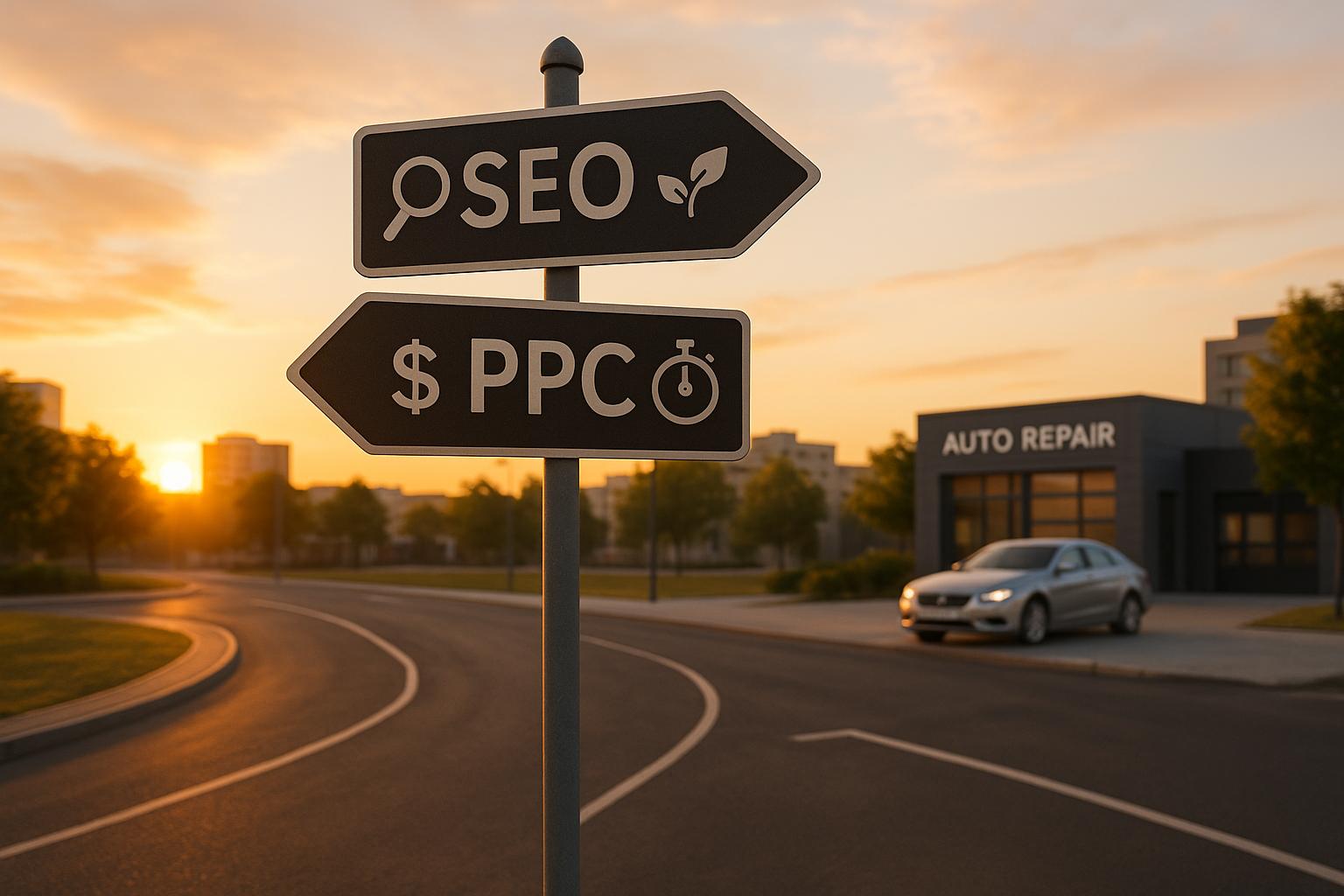
When trying to attract more customers to your auto repair shop, SEO and PPC are two of the most effective strategies. Here’s the bottom line: SEO is great for long-term growth, while PPC delivers immediate results. Choosing the right approach depends on your budget, timeline, and goals.
- SEO (Search Engine Optimization): Focuses on improving your website’s organic search rankings. It’s ideal for building trust and generating steady traffic over time. However, it can take 3–6 months or longer to see results.
- PPC (Pay-Per-Click): Places your ads at the top of search results instantly. It’s perfect for attracting quick traffic but requires ongoing spending, as visibility ends when your budget runs out.
Key Takeaways:
- Use PPC if you need fast results, like filling appointment slots quickly.
- Invest in SEO for a lasting online presence and cost-effective traffic over time.
- Combining both can help you achieve short-term wins while building a strong foundation for the future.
Here’s a quick comparison to help you decide:
| Factor | SEO | PPC |
|---|---|---|
| Time to Results | 3–6 months or longer | Immediate |
| Cost | No per-click fees after setup | Pay for every click |
| Result Duration | Long-lasting with maintenance | Ends when spending stops |
| Targeting | Broad, organic search reach | Precise audience targeting |
For the best results, consider starting with PPC for quick visibility while building your SEO strategy in the background. Both strategies can work together to drive more customers to your shop.
SEO vs. PPC: Which Is Better?
SEO and PPC Basics for Auto Repair Businesses
Understanding SEO and PPC can help you attract more local customers to your auto repair shop. These two strategies play different roles in your marketing efforts, and knowing how they work can guide your decisions on where to allocate your time and budget.
What SEO Means for Auto Repair Shops
Search Engine Optimization (SEO) is all about improving your website and online presence to rank higher in unpaid search results. For auto repair shops, this means optimizing your website, Google Business Profile, and content so that when someone searches for "brake repair near me" or "oil change in [your city]", your business stands out in the results.
SEO helps search engines understand what your business offers and where you’re located. By using relevant keywords, creating content about your services, and ensuring your business details are consistent across online directories, platforms like Google will see your shop as a trustworthy and relevant option for local searches.
Local SEO is especially important because most customers look for nearby solutions when their car needs immediate attention. This ensures your shop shows up in "near me" searches and appears in Google Maps results, making it easier for potential customers to find you when they need help.
SEO is about reaching customers at the right moment. If your website ranks highly for searches like "transmission repair" or "car won’t start", you’re connecting with people actively looking for solutions. While SEO takes time to build organic visibility, it’s an essential long-term strategy for attracting consistent traffic. For faster results, PPC is your go-to option.
What PPC Means for Auto Repair Shops
Pay-Per-Click (PPC) advertising is a model where you pay a fee each time someone clicks on your ad. Unlike SEO, which takes time to grow, PPC gives your business instant visibility by placing your ads above organic search results.
Google Ads is the most popular platform for PPC campaigns, allowing your shop to appear at the top of search results for terms like "auto repair near me." With PPC, you can start seeing results within hours, making it a quick way to attract customers who are ready to book your services.
PPC works through an auction system. When someone searches for a term like "brake repair near me", Google holds a split-second auction among businesses bidding on that keyword. The winning ads are displayed at the top of the page, marked with a small "Ad" label.
One of PPC’s biggest advantages is precise targeting. You can set your ads to appear only to people within a certain distance from your shop, ensuring your budget is spent on potential customers who are likely to visit. You can also customize your campaigns to target specific demographics, times of day, or even exclude areas you don’t serve.
With PPC, you only pay when someone clicks on your ad and visits your website, making it a cost-effective way to attract interested customers. This model ensures your budget goes toward generating actual leads rather than just displaying ads.
The automotive industry thrives on digital engagement. For example, 25% of auto-related web searches focus on services, and more than 100 million searches per month in the U.S. are about tires. In the first half of 2020, online conversion rates for vehicle repair and maintenance rose by 44%, highlighting how customers increasingly rely on digital channels to find and book services.
Both SEO and PPC capitalize on the fact that 93% of all online experiences start with a search engine. Whether through organic rankings or paid ads, having a presence in search results is crucial to capturing customers when they need your services the most.
Main Differences Between SEO and PPC for Auto Repair
SEO and PPC serve distinct purposes when it comes to attracting customers, especially when you consider the timelines they operate on.
Speed: Immediate Impact vs Gradual Growth
PPC is all about instant results. As soon as your campaign goes live, your ads can start appearing in search results, drawing attention to your auto repair shop right away. On the flip side, SEO requires patience. It’s a long-term strategy where most shops begin to see noticeable improvements in rankings after 3–6 months of consistent effort. If you’re in a competitive market or just starting out, it could take even longer to make a significant impact.
Now, let’s look at how each approach sustains results over time.
Duration: Short-Term Push vs Long-Term Presence
PPC only works as long as you’re actively funding your campaigns. The moment your budget runs out, your ads vanish from search results. SEO, however, offers a more enduring payoff. With a solid SEO strategy, once your site achieves strong rankings for important keywords, you can continue to attract traffic with occasional updates and maintenance.
In essence, PPC gives you a quick boost in visibility, while SEO lays the foundation for sustained growth. Choosing between the two depends on whether you’re prioritizing short-term traffic spikes or long-term online presence.
Here’s a quick comparison of how timing affects both strategies:
| Factor | PPC | SEO |
|---|---|---|
| Time to Results | Immediate | 3–6 months or longer |
| Result Duration | Ends when ad spending stops | Lasting with periodic effort |
Understanding these timing differences can help you decide which approach aligns better with your business goals, whether it’s meeting immediate needs or building a lasting digital footprint.
SEO and PPC Advantages and Drawbacks for Auto Repair
When deciding how to market your auto repair business, weighing the pros and cons of SEO and PPC can help you align your strategy with both immediate and long-term goals. Each approach has its strengths and challenges, and understanding these trade-offs is key to making an informed decision.
SEO Benefits and Challenges for Auto Repair
SEO can deliver long-lasting results for auto repair shops. Once your website ranks well for keywords like "brake repair near me" or "oil change [your city]", you can attract a steady flow of organic traffic without paying for every click or visit. Over time, this makes SEO a cost-effective strategy.
Another major advantage is the trust factor. Customers often see businesses that rank high in organic search results as more credible and established. This perception can boost your reputation as a reliable player in your local market. Additionally, a well-optimized site can target multiple keywords, allowing you to reach potential customers at various stages of their decision-making process.
However, SEO isn’t without its challenges. Results can take months to materialize, which might not work for new shops or businesses seeking quick wins. It also requires ongoing effort – regular content updates, technical tweaks, and adapting to search engine algorithm changes are necessary to maintain strong rankings.
SEO can also be unpredictable. Algorithm updates or increased competition might impact your rankings, potentially reducing traffic and leads unexpectedly.
| SEO Aspect | Benefits | Challenges |
|---|---|---|
| Cost | Generates organic traffic without per-click fees once established | Requires ongoing investment in updates and optimization |
| Timeline | Builds long-term visibility | Results take months to appear |
| Trust | Boosts credibility through organic rankings | Rankings can be affected by algorithm changes |
| Coverage | Targets a wide range of relevant search terms | Limited direct control over rankings |
For auto repair shops needing quicker results, SEO’s slower timeline might make it less appealing as a standalone strategy.
PPC Benefits and Challenges for Auto Repair
PPC, on the other hand, offers a faster route to visibility. With PPC ads, your shop can appear at the top of search results almost immediately, making it a great option for filling appointment slots or promoting limited-time offers.
PPC also excels in targeting. You can customize your ads based on location, time of day, and specific audience characteristics, ensuring your message reaches the right people. Plus, PPC platforms provide detailed analytics, allowing you to track spending, clicks, and conversions. This level of measurability makes it easier to calculate ROI and adjust campaigns in real time.
Another advantage is flexibility. You can start with a small budget, test different keywords or ad messages, and scale up based on what works. This adaptability helps reduce risk while you fine-tune your approach.
However, PPC comes with its own set of challenges. Costs can add up quickly since you pay for every click. Once your budget runs out or the campaign ends, the traffic stops immediately, making PPC highly dependent on continuous spending.
There’s also the risk of click fraud, where invalid clicks – whether from bots or competitors – drain your budget without delivering real leads. Unlike SEO, PPC doesn’t build lasting assets; its benefits disappear as soon as you stop paying.
| PPC Aspect | Benefits | Challenges |
|---|---|---|
| Speed | Delivers immediate traffic and visibility | Traffic stops when spending stops |
| Targeting | Allows precise audience and location targeting | Comes with ongoing costs for each interaction |
| Measurement | Provides detailed analytics for ROI tracking | Vulnerable to click fraud |
| Flexibility | Enables quick budget and campaign adjustments | Does not create lasting digital assets |
Choosing between SEO and PPC ultimately depends on your shop’s goals and resources. By understanding the strengths and limitations of each approach, you can decide which strategy – or combination of strategies – best supports your auto repair business.
sbb-itb-02fe772
Combining SEO and PPC for Better Results
SEO and PPC don’t have to compete – they can actually work together to drive better results for auto repair shops. By combining the instant feedback and visibility of PPC with the long-term traffic-building power of SEO, you create a strategy that’s both dynamic and sustainable. Together, these approaches offer valuable insights you can act on.
Using PPC Data to Improve SEO
Think of PPC campaigns as a testing ground for your SEO strategy. The real-time data from PPC can guide your long-term SEO efforts in a way that’s both strategic and efficient.
For example, auto repair businesses can analyze PPC keyword and conversion data to refine their SEO approach. If your PPC campaign shows that "transmission repair [your city]" performs better than "transmission service [your city]", it’s a clear signal to prioritize the higher-performing term in your SEO plan. This not only sharpens your keyword focus but also helps optimize your content strategy based on what’s already proving effective.
PPC campaigns also reveal which ad copy and landing page elements are driving conversions. Use this insight to test content ideas quickly before committing to full-scale SEO content creation. It’s like having a sneak peek into what resonates with your audience.
Additionally, PPC provides intent data that’s invaluable for shaping your SEO strategy. While SEO often targets long-term, discovery-based searches, PPC focuses on more immediate, transaction-driven intent. By leveraging PPC data, you can align your SEO efforts to capture both immediate opportunities and long-term traffic. This dual focus ensures your strategy is balanced and effective.
Action Steps for Auto Repair Businesses
Choosing the best marketing strategy for your auto repair shop means taking a close look at your timeline, budget, and how you stack up against the competition.
How to Choose Between SEO and PPC
Start by assessing your specific needs and goals.
If you’re looking for quick results to bring in customers right away, PPC (Pay-Per-Click) advertising is your go-to option. It offers immediate visibility and can help fill your bays fast. On the other hand, if you’re thinking long-term and want to build a steady stream of customers over time, SEO (Search Engine Optimization) is the better choice. SEO focuses on creating lasting online visibility, making it ideal for businesses with tighter monthly budgets looking for sustainable returns.
In competitive local markets, PPC can give you the edge by grabbing attention quickly. But in areas with less competition, a strong SEO strategy can help you climb search rankings faster. Often, combining the two strategies works best – using PPC for short-term gains while building a solid SEO foundation for the future.
Once you’ve decided on your primary approach, the next step is to focus on optimizing for local customers.
Local SEO and Local PPC Best Practices
After choosing your strategy, it’s time to fine-tune your local marketing efforts with targeted SEO and PPC tactics.
Local marketing is essential because most customers look for services close to home. A strong presence in local search results, paired with well-targeted ads, ensures you connect with nearby customers actively searching for your services.
For local SEO, start by optimizing your Google Business Profile. Make sure your business name, address, and phone number (NAP) are consistent across all directories. Keep your profile fresh by adding quality photos of your shop, team, and recent work. Encourage satisfied customers to leave positive reviews – these reviews can significantly boost your visibility and credibility.
Take your website a step further by creating location-specific content. Instead of relying solely on generic service pages, develop pages or blog posts that highlight your services in specific neighborhoods or near popular local landmarks. This approach helps attract customers who are searching for services in your immediate area.
For local PPC campaigns, use tools like location extensions and radius targeting to focus your ads on users within your service area. This ensures your budget is spent on reaching the right audience. Ad scheduling is another smart move – align your ads with your business hours and peak demand times. Features like call extensions can also make it easier for mobile users to reach you directly.
Finally, keep an eye on the metrics that matter. For local SEO, track views, direction requests, and phone calls to understand how customers are finding you. For local PPC, focus on cost per lead and conversion rates to measure how effectively your ads are turning clicks into appointments. The ultimate goal? More cars in your bays and more satisfied customers walking through your doors.
Conclusion: Choosing the Right Marketing Mix for Auto Repair
Deciding between SEO and PPC for your auto repair business isn’t about choosing one and ignoring the other – it’s about recognizing what each can offer and how they align with your goals.
Here’s the deal: PPC delivers fast results. It’s perfect for driving immediate traffic, promoting seasonal deals, or quickly attracting new customers. However, it comes with a cost – you’re paying for every click.
On the other hand, SEO focuses on building long-term visibility. While it requires patience and time to see results, it creates a consistent flow of customers without the ongoing expense of per-click fees.
The smartest approach? Combine both strategies. Use PPC to generate immediate leads while SEO works in the background, building a sustainable presence. Plus, PPC data can help fine-tune your organic keyword strategy, and appearing in both paid and organic search results boosts your credibility.
Your decision should reflect your budget, timeline, and local competition. If resources are tight, SEO is a great starting point. If you need quick results, PPC should take priority. Ideally, a blend of both will set the stage for long-term success.
Start with clear goals, monitor your progress, and adapt your strategy as your business and market grow.
FAQs
What’s the best way to allocate my budget between SEO and PPC to attract more customers to my auto repair shop?
Balancing your marketing budget between SEO and PPC hinges on your specific goals, timeline, and available resources. SEO focuses on long-term growth by enhancing your website’s visibility in organic search results, gradually bringing in steady traffic. In contrast, PPC offers immediate visibility by placing your business at the top of search results through paid advertisements.
If you’re looking for quick wins – like filling last-minute appointment slots or promoting a limited-time deal – PPC can deliver fast results. At the same time, allocating part of your budget to SEO helps establish a solid foundation for ongoing, sustainable growth. Taking a balanced approach allows you to capitalize on both short-term gains and long-term opportunities.
Keep an eye on key performance indicators such as cost-per-click (CPC), return on ad spend (ROAS), and organic traffic trends. Regularly reviewing these metrics will help you fine-tune your spending and ensure your budget delivers the best possible results.
How can I optimize my auto repair shop’s local SEO to rank higher in ‘near me’ searches?
To help your auto repair shop show up higher in local "near me" searches, you’ll want to focus on a few important tactics:
- Claim and fine-tune your Google Business Profile: Make sure every detail about your business is correct – your address, phone number, hours, and the services you offer. Add clear, high-quality photos of your shop and encourage happy customers to leave positive reviews.
- Use location-based keywords: Sprinkle phrases like your city or neighborhood alongside your services throughout your website. For example, "brake repair in Dallas" can work well in your headings, meta descriptions, and site content.
- Keep your NAP (Name, Address, Phone) consistent: Double-check that your contact details match perfectly across all online directories and platforms. This consistency helps search engines trust your business.
These steps can make your shop more visible to nearby customers searching for services you provide.
How can I use data from PPC campaigns to improve my SEO strategy for my auto repair business?
PPC campaign data offers a treasure trove of insights that can sharpen your SEO strategy. By diving into metrics like keyword performance, click-through rates, and conversion data, you can pinpoint the search terms that drive the most traffic and leads. Using these high-performing keywords in your website content can gradually enhance your organic search rankings.
Beyond keywords, PPC data provides a window into customer behavior. It can highlight trends like the most sought-after services or shifts in seasonal demand. Armed with this information, you can craft targeted content and fine-tune your SEO efforts to match what your audience is actively searching for – boosting both your visibility and overall results.