Your auto shop’s online reputation directly impacts customer decisions and revenue. 97% of people read local business reviews, and 90% rely on positive reviews to choose a business, while 87% avoid shops with low ratings. Boosting your rating by just one star can increase revenue by 5–9%. Here’s how to manage and improve your reputation effectively:
- Audit Your Online Presence: Check Google, Yelp, Facebook, and industry-specific platforms like Cars.com. Use alerts to monitor new reviews.
- Encourage Positive Reviews: Automate review requests via text or email, and train staff to ask for feedback during checkout.
- Respond to Reviews: Reply to all feedback within 24–48 hours. Thank customers for positive reviews and professionally address negative ones.
- Build Long-Term Trust: Incorporate feedback into daily operations, connect reviews with loyalty programs, and display customer testimonials.
- Leverage Marketing Tools: Services like Auto Repair Leads Pro can help optimize your shop’s visibility and attract more customers.
Managing your shop’s reputation isn’t a one-time task. It’s about consistently improving customer experience, engaging with reviews, and staying visible online to build trust and loyalty.
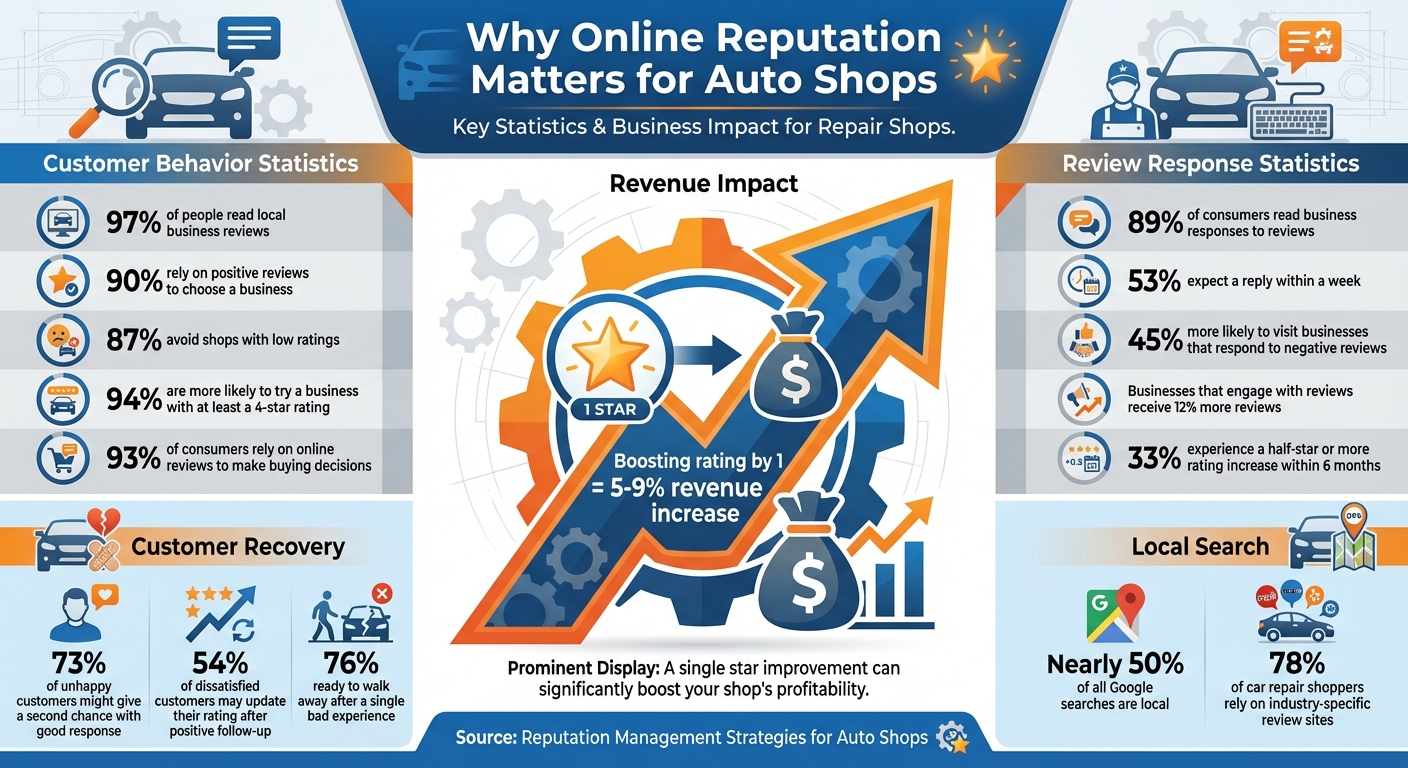
Auto Shop Online Reputation Statistics and Impact on Revenue
Leveraging Online Reviews & Reputation Management for Auto Repair Shops
Step 1: Review Your Current Online Reputation
Start by evaluating your shop’s online presence. Search for your business on platforms like Google, Yelp, and Facebook to see what customers are saying. Don’t forget industry-specific sites like DealerRater, Carwise, and Cars.com – 78% of car repair shoppers rely on these for reviews. To stay on top of new feedback, set up alerts on Google and Yelp.
Check All Major Review Platforms
Dive into your reviews to uncover patterns and actionable insights. Look for specific comments about fast service, communication issues, or standout team members. These details can help you understand what’s working and what needs attention. Monthly review activity also signals local relevance to Google.
Pay close attention to the balance between positive and negative reviews. Recurring complaints – whether about pricing, wait times, or follow-up – highlight areas where you can improve. Keep in mind, 94% of people are more likely to try a business with at least a four-star rating.
Once you’ve gathered your review data, compare it against local competitors. This will help you identify where you’re excelling and where there’s room to grow.
Compare Your Reputation to Competitors
Take a close look at how your shop stacks up against the competition. Compare your star ratings, the number of reviews, and recent feedback with theirs. For example, if a competitor has 150 reviews and you only have 30, use that as a growth target.
Pay attention to what customers love about your competitors. Are they getting recognition for services you also provide but aren’t being noticed for? Study how they respond to reviews – both positive and negative. Their strategies might offer clues on how to better connect with your local audience. Even small changes, like improving your review score by just one star, can lead to a 5-9% revenue increase.
Step 2: Get More Positive Reviews Consistently
Make it a habit to ask every happy customer for a review. On average, about 20% of customers will respond with feedback – so if you serve 100 customers, you can expect around 20 new reviews. To make this process seamless, automate your review requests. Research shows that 85% of customers are willing to leave a review if it’s simple and convenient. The key is to eliminate any hurdles between a good experience and a glowing five-star review.
Set Up Automated Review Requests
Integrate your point-of-sale system or shop management software to automatically send review requests right after a service is completed. Text messages are especially effective, boasting a 98% open rate compared to just 20% for emails. Timing is everything – send the request within an hour to capture customers while their positive impressions are still fresh.
Personalization helps too. Address the customer by name and include a warm thank-you for their business. Add a one-tap link that directs them straight to your Google Business Profile or another review platform. The fewer steps they need to take, the more likely they are to leave a review. You can also guide feedback by highlighting your strengths. For example, if quick service is your edge, ask something like, "How was your experience with our fast service?".
Train Your Staff to Ask for Reviews
Your team plays a vital role in generating reviews. Train your service advisors and technicians to ask for feedback – it’s a simple step, and most customers will respond positively when prompted. Make it part of their regular checkout routine.
Create a workplace culture where feedback is valued and customer service shines. When employees greet customers with clear communication and a friendly attitude, asking for a review feels natural. For instance, they could say, "We’d really appreciate it if you could share your experience on Google. It helps other car owners find us." This approach not only shows that you care about their input but also builds trust, encouraging honest and positive reviews. Encourage your team to make this ask part of every interaction with customers.
Step 3: Respond to Reviews the Right Way
How you respond to customer reviews speaks volumes about your business. In fact, 89% of consumers read these responses, using them as a measure of your dedication to customer care. A well-crafted reply doesn’t just address the reviewer – it builds trust with everyone who sees it.
Timeliness is key. Aim to respond within 24–48 hours, especially when dealing with negative feedback. Why? Because 53% of customers expect a reply within a week. Businesses that consistently engage with reviews see real results: they receive 12% more reviews and about 33% of them experience a half-star or more increase in ratings within six months. With that in mind, let’s break down how to handle both positive and negative reviews effectively.
How to Reply to Positive Reviews
When a customer takes the time to leave a glowing review, always respond with gratitude. Acknowledge their effort by personalizing your reply – use their name and reference specific details from their feedback. For instance, if someone highlights your team’s efficiency, you could say:
"Thank you, Sarah, for your kind words about John’s expertise! We’re thrilled your car is running smoothly. Team members like John are the heart of our commitment to quality."
This kind of tailored response not only shows appreciation but also reinforces your business’s core values. To keep things fresh, vary your language. Instead of always saying "thank you", mix in phrases like "we’re grateful for", "we appreciate", or "it means a lot to us". It adds a personal touch and keeps your responses engaging.
How to Handle Negative Reviews
Negative reviews may feel discouraging, but they’re a chance to demonstrate professionalism and win customers back. Consider this: 45% of consumers are more likely to visit a business that responds to negative reviews, and 73% of unhappy customers might give you a second chance if you handle their concerns well. Even more encouraging, 54% of dissatisfied customers may update their rating after a positive follow-up experience.
Before replying, take a moment to assess the situation. Your response should be calm, professional, and solution-focused. Start by addressing the reviewer by name, thanking them for their feedback, and apologizing briefly. Then, outline how you plan to address the issue. For example:
"We’re sorry to hear about your experience with the brake service. This doesn’t meet our standards. We’d like to make this right with a complimentary re-inspection. Please call us at (555) 123-4567 so we can discuss this directly."
sbb-itb-02fe772
Step 4: Create a Long-Term Reputation Plan
While responding to reviews is essential, building a strong reputation requires a consistent, long-term approach. Reputation management isn’t a one-and-done task – it’s an ongoing effort that keeps your shop in the spotlight and earns customer trust. Many drivers remain cautious about auto shops due to past negative experiences, so establishing trust over time can set your shop apart. By integrating reputation-building into daily operations, you complement your review management efforts and create a foundation for lasting customer relationships.
Make Reputation-Building Part of Everyday Operations
Reputation management works best when it’s woven into the fabric of your shop’s daily activities. This includes tying customer loyalty initiatives to feedback collection, sharing real success stories, and consistently monitoring your shop’s reputation. When this becomes second nature, you’ll see sustained growth and stronger connections with your customers.
Connect Loyalty Programs with Feedback Collection
Loyalty programs not only reward customers but also encourage valuable feedback. When customers feel valued – whether through discounts or perks – they’re more inclined to share their experiences. These programs are an excellent way to gather reviews while strengthening customer loyalty.
For instance, you could offer a 10% discount on their next service if they complete a feedback form before leaving. This approach not only collects reviews but also reinforces long-term loyalty. To make it even easier, promote your loyalty program on digital displays in your waiting area and include QR codes that link directly to sign-up pages or feedback forms. In November 2023, UPshow CONNECT demonstrated how digital signage could help auto shops showcase loyalty program details, direct customers to surveys via QR codes, and offer service discounts for participation.
The key is to act on the feedback you receive. When customers notice their input leading to real improvements, they’re more likely to become enthusiastic supporters of your shop.
Highlight Testimonials and Success Stories
Nothing speaks louder than the voices of your satisfied customers. Displaying testimonials on your website, social media, and even in-shop can make a significant impact.
Use a mix of formats to share reviews, such as website links, social media posts, and video testimonials. Video content, in particular, is a compelling way to bring customer feedback to life. You can streamline this process by using automated software that prompts customers to share specific details about their experiences. These efforts not only enhance your reputation but also create a solid foundation for future growth and customer trust.
Step 5: Use Auto Repair Leads Pro for Better Reputation Results
Once you’ve tackled review management and customer engagement, it’s time to take your reputation to the next level with focused marketing. A strong reputation only works if the right audience sees it. That’s where Auto Repair Leads Pro comes in. This service specializes in marketing for automotive repair shops, helping you attract high-quality leads and strengthen your online presence. And with 93% of consumers relying on online reviews to make buying decisions, combining great service with smart marketing can be a game-changer for your business. Here’s how custom marketing plans and local SEO can help your shop shine.
Custom Marketing Plans Designed for Your Shop
Every auto repair shop has its own set of challenges and goals. Auto Repair Leads Pro creates tailored marketing strategies to address these needs, offering everything from lead-focused website design to advanced analytics. By drawing in customers who prioritize quality service, you’ll naturally gain more positive reviews and build lasting relationships. Their plans are flexible – whether you need basic SEO and PPC setup or a more comprehensive package with local SEO and customer-centric campaigns, there’s an option to fit your budget. These personalized approaches also help your shop succeed in local search rankings.
Boost Local Search Rankings with SEO
Did you know that nearly half of all Google searches are local? Auto Repair Leads Pro uses SEO strategies to optimize your Google Business Profile and website with location-specific keywords, increasing your visibility in the coveted Google 3-Pack. Plus, businesses with strong ratings and consistent reviews are more likely to rank higher on platforms like Google, giving you an edge locally. If you’re running PPC campaigns, the benefits can be impressive – on average, businesses earn $2 for every $1 spent on Google Ads. As more potential customers find your shop online, delivering top-notch service will naturally lead to glowing reviews and a stronger reputation over time.
Conclusion
Your reputation is the cornerstone of your success. With 93% of consumers turning to online reviews before making a purchase decision, and 76% ready to walk away after a single bad experience, managing your reputation is no longer optional – it’s essential for auto repair shops. The ability to monitor, respond to, and shape your online presence can make the difference between thriving and struggling.
Here’s a quick recap of the steps outlined in this guide: Start by auditing your online presence to understand how your business is perceived. Focus on generating positive reviews and engage with every piece of feedback you receive. Make it a habit to regularly check your digital footprint across platforms, implement systems to consistently collect reviews, and respond to customer feedback – good or bad – within 24–48 hours. The best-performing auto brands respond to reviews in just over a day on average (1.21 days), proving that prompt and consistent communication sets leaders apart.
Beyond reviews, invest in transparent communication, modern diagnostic tools, and staff training. When paired with strategic marketing, these efforts build a reputation that attracts loyal, high-quality customers. This comprehensive approach, as outlined earlier, creates trust and credibility while driving growth in your local market.
Reputation management isn’t a one-and-done task. It’s an ongoing process that thrives on customer feedback. Use that feedback to refine and improve your services continuously. By committing to this long-term strategy, you’ll establish a strong foundation for success that stands the test of time.
FAQs
How can I get more customers to leave positive reviews for my auto shop?
Providing great service is the foundation for earning positive reviews. When customers leave feeling satisfied and cared for, they’re far more likely to share their experience – especially if the process is quick and they know their feedback is appreciated.
Here’s how you can encourage more reviews:
- Ask at the right moment: Timing matters. Right after finishing a service, especially if the customer seems pleased, is a perfect time to politely request a review.
- Simplify the process: Make it effortless by sharing a direct link or QR code that leads to a review platform like Google Reviews. A brief follow-up email or text can also serve as a helpful reminder.
- Show your appreciation: Always thank customers for taking the time to leave a review. Respond to their feedback promptly to demonstrate that their input truly matters to you.
By pairing outstanding service with a seamless review process and genuine engagement, you can enhance your shop’s reputation, draw in more customers, and build lasting trust.
How should I respond to negative reviews to turn unhappy customers into loyal ones?
The smartest way to handle negative reviews? Respond quickly and with professionalism. Start by thanking the customer for taking the time to share their thoughts, and offer a genuine apology for their less-than-ideal experience. Show that you understand their concerns – without getting defensive – and make it clear you’re committed to addressing the issue.
If possible, take the conversation offline. Offer to connect through email or a phone call to work toward a resolution. This not only shows the reviewer that their satisfaction matters to you, but it also signals to others that you take feedback seriously and act on it. A well-thought-out, compassionate reply can go a long way in rebuilding trust – and might even turn a negative review into a positive outcome.
How does enhancing my auto shop’s online reputation boost revenue?
Building a strong online reputation for your shop can have a direct impact on your revenue by establishing trust with potential customers. People often turn to reviews before making a decision, and positive feedback paired with a solid online presence can make your services the clear choice.
A good reputation doesn’t just build trust – it can also improve your shop’s visibility in search results. When local customers can find you easily and see glowing reviews, they’re more likely to book appointments. Over time, this leads to more repeat business and loyal customers who keep coming back.