Marketing automation simplifies repetitive tasks like sending reminders, follow-ups, and notifications, saving time and improving efficiency. Auto repair shops can benefit significantly, saving up to 18 hours weekly while improving customer retention. Here’s a quick breakdown of how to implement it:
- Step 1: Assess your current marketing efforts and set clear goals (e.g., increase appointment show rates or customer retention).
- Step 2: Choose tools that integrate with your existing systems (e.g., CRM, SMS, DMS) and support email campaigns, service reminders, and review management.
- Step 3: Organize your customer database with segmentation based on service history, vehicle type, and visit frequency.
- Step 4: Create automated workflows for tasks like appointment reminders, review requests, and seasonal service campaigns.
- Step 5: Track performance metrics like open rates, click-through rates, and ROI to refine campaigns.
Key tip: Automating processes like appointment confirmations and follow-ups can reduce missed appointments by 30% and boost repeat business by 25%. Start small, track results, and adjust to maximize impact.
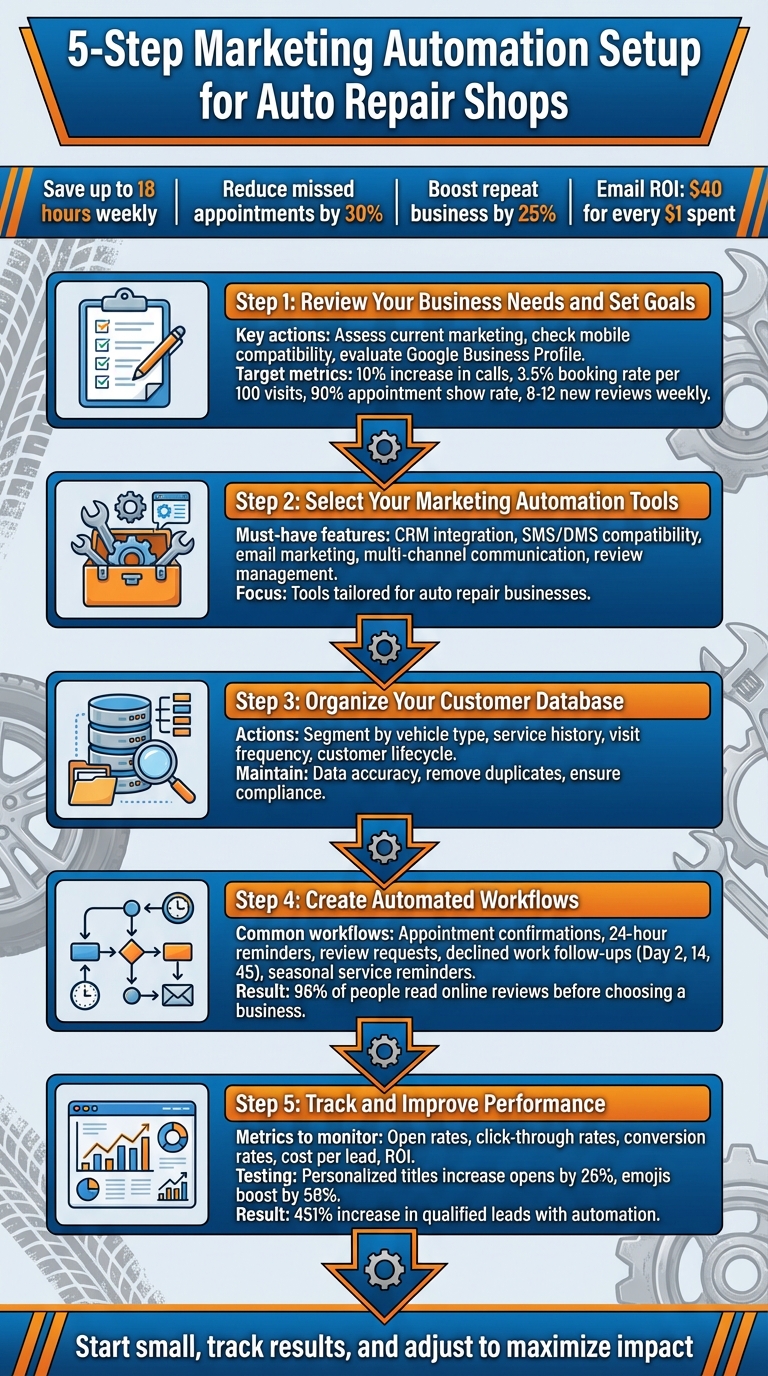
5-Step Marketing Automation Setup Process for Auto Repair Shops
Step 1: Review Your Business Needs and Set Goals
Review Your Current Marketing Activities
Before diving into automation, it’s important to take stock of your current marketing efforts. Start by checking your website’s mobile compatibility using Google’s Mobile Friendly Test. This is crucial because over 85% of people use the internet to find local auto shops. Evaluate how you’re managing tasks like service reminders, thank-you notes, and follow-ups for declined work. Are these processes taking up too much time or, worse, being overlooked altogether?
Next, assess your Google Business Profile, social media platforms, and any paid advertising campaigns. Did you know that 41% of clicks on a search results page go to one of the top three paid ads? If you’re running Google Ads, track whether those clicks are actually converting into appointments. Also, take a close look at your customer database – are you segmenting it by vehicle type, service history, or location? Pinpointing these gaps will help you identify where automation can make the most difference.
This evaluation provides a clear roadmap for setting measurable goals.
Set Clear and Measurable Goals
Vague goals won’t get you far. Instead, set specific, actionable targets. For example, Garage360’s "2025 Playbook" suggests metrics like increasing calls from your Google Business Profile by 10%, achieving at least a 3.5% booking rate per 100 website visits, maintaining a 90% appointment show rate, and earning 8–12 new reviews each week.
If missed appointments are costing you money, consider automating appointment confirmations and reminders. Struggling with customer retention? Set up automated service reminders for routine tasks like oil changes or tire rotations. Need to recapture lost revenue? Aim to recover at least 25% of declined work within 30 days using automated follow-ups. With email marketing delivering an average ROI of $40 for every $1 spent, automated communications aren’t just efficient – they’re a smart financial move.
Step 2: Select Your Marketing Automation Tools
Features to Look For
Once you’ve assessed your business needs and goals, the next move is picking the right automation tool. One of the most important factors is ensuring that the tool integrates smoothly with your existing systems. Specifically, it must work seamlessly with your SMS or DMS. Without this integration, you could face inefficiencies and the hassle of manual data transfers.
Check for tools that highlight open API capabilities or ready-made integrations with popular DMS platforms. This allows customer data, service histories, and appointment schedules to flow effortlessly between systems. An integrated CRM is just as essential. It should help you gather and organize customer data, monitor preferences and behaviors, and automate routine communications.
Multi-channel communication features are another must. Look for tools that offer email marketing capabilities like customizable templates, drag-and-drop builders, mass email scheduling, and triggered emails that send automatically based on customer actions.
To enhance transparency and build trust, consider tools that offer Digital Vehicle Inspections (DVIs). These can increase service approval rates while improving your customer relationships. Additionally, platforms with review management and local SEO tools should be high on your list. Your online reputation is just as crucial as the service you provide in your shop.
Tools for Auto Repair Businesses
With these features in mind, focus on tools tailored specifically for auto repair businesses. Automotive CRMs designed for this industry offer deeper integrations with dealer systems and workflows. These solutions are built to handle unique needs like tracking vehicle service histories and managing parts inventory.
When exploring your options, think about how these tools fit into your broader marketing strategy. For example, if you’re already using Auto Repair Leads Pro for website development, SEO, or PPC advertising, ask about tools that complement those services. Their advanced analytics and reporting features can help you measure which automated campaigns are driving appointments and boosting revenue. This groundwork will set you up to efficiently organize your customer database in the next step.
Step 3: Organize Your Customer Database
Segment Your Customer Lists
Breaking your customer database into smaller, specific groups can make your marketing efforts much more effective. This process, called customer segmentation, involves grouping customers based on shared traits so you can send them more relevant messages. It’s a smart way to fine-tune your targeting and improve customer retention.
Start by using data from your dealership management system (DMS), which is usually the go-to source for this kind of information. You can create segments based on factors like the type of vehicle they own, their service history, how often they visit, or where they are in the customer lifecycle. For example, luxury car owners likely have different expectations compared to those driving economy cars. Similarly, someone who only comes in for routine oil changes might need a different approach than a customer interested in full-service maintenance. By tailoring your marketing messages to these distinct groups, your automated campaigns will resonate more effectively.
Once you’ve set up these segments, make sure your database remains a reliable resource by keeping it accurate and compliant.
Maintain Data Accuracy and Compliance
After segmenting your database, the next step is to keep it clean and reliable. Accurate information is the backbone of successful marketing automation. Regularly check and update customer records to remove duplicates, fix errors, and get rid of outdated or incomplete entries.
One way to simplify this task is by using tools like IDP with OCR and NLP. These technologies can automatically pull useful data from repair invoices and service records, reducing manual errors and saving time. Additionally, keeping track of detailed customer and vehicle histories – such as past services, parts used, comments on orders, and feedback – helps you set up the personalized workflows you’ll use in the next stages. By staying on top of data accuracy, you’ll ensure your database continues to be a powerful tool for your marketing efforts.
Step 4: Create Automated Workflows
Common Workflows for Auto Repair Shops
Automated workflows can simplify routine communications and keep your shop running smoothly. Start with appointment confirmations – send automated SMS messages that include appointment details and offer easy rescheduling options. To cut down on no-shows, follow up with a reminder 24 hours before the appointment.
After a customer makes a payment, trigger an immediate request for a review. If no review is received within 24 hours, send a polite follow-up. This strategy taps into the fact that 96% of people read online reviews before deciding on a local business.
For declined work, set up automated follow-ups to recover missed opportunities. Tag declined repair lines on service orders and, with the customer’s permission, initiate a three-step follow-up sequence – on Day 2, Day 14, and Day 45. This approach can help turn declined services into booked appointments.
Seasonal service reminders are another powerful tool. Use each customer’s service history to send targeted reminders, like battery tests or preventive maintenance in colder months, or A/C checks and road-trip inspections in the spring. Tailoring these workflows to individual customer needs can make your communications far more effective.
Personalization Tips for Better Engagement
Generic messages are easy to ignore. Instead, use data like vehicle type and service history to craft messages that feel personal. For instance, a luxury car owner may need different service intervals and a more formal tone compared to someone driving an economy car. You can also automate maintenance reminders based on mileage or time – like sending an oil change reminder every 5,000 miles or six months.
Make sure customer replies to your automated messages go straight to your service advisors. Quick responses can turn interest into appointments, which is crucial when you consider that email marketing can deliver an average return of $36 for every $1 spent.
To streamline the process even further, integrate your website’s booking forms with your shop management system. This way, service tickets are created automatically, ensuring every interaction contributes to a smooth and efficient customer experience. The results can be impressive – personalized marketing has the potential to boost revenue by 40%.
sbb-itb-02fe772
Step 5: Track and Improve Performance
Metrics to Track
To fine-tune your email marketing efforts, start by keeping an eye on key metrics like open rates, click-through rates, and conversion rates. These numbers can tell you a lot about how well your campaigns are performing. Did you know that email marketing in the automotive sector delivers an impressive ROI of $40–44 for every dollar spent?. Beyond these, monitor cost per lead, cost per acquisition, revenue per campaign, list growth, and unsubscribe rates to get a complete picture of your campaign’s success.
Interestingly, marketing automation offers a solid return as well, with an average of $5.44 earned for every dollar invested over three years. Even better, 44% of companies that adopt marketing automation see profitability within just six months.
"Marketing without data is like driving blindfolded. If you don’t know which efforts bring customers in, you’re wasting money and missing out on growth opportunities." – Taran Sodhi, Conceptual Minds
Test and Adjust Campaigns
Metrics are only as good as the actions they inspire. Use this data to identify areas that need attention. For example, test one variable at a time – such as the subject line, send time, or call-to-action – to understand what drives better engagement. Personalizing email titles can increase open rates by 26%, and adding emojis might boost them by up to 56%. When testing, allow 2–12 hours to analyze open rates or 12–24 hours to gauge revenue impact.
If your open rates are dropping, it could mean there’s an issue with your sequencing or targeting. Low click-through rates might point to content that isn’t connecting with your audience, while high bounce rates could signal that your landing pages need some work. Keep a record of your test results and use them to refine your campaigns. Personalized campaigns, for instance, can deliver 5–8x better ROI compared to generic messaging. By consistently analyzing and adjusting, you can ensure your marketing automation stays effective and aligned with your goals.
Conclusion
Key Takeaways
Getting started with marketing automation doesn’t have to be complicated. Start by selecting tools that align with your budget and offer practical features like customer segmentation, automated appointment reminders, and email campaigns. Focus on tailoring your messages based on customer preferences and service history, while keeping an eye on performance metrics to see what’s working. These strategies are designed to tackle common challenges for auto repair shops, like limited time and customer retention, by streamlining communication and maintaining consistent engagement.
Here’s why this matters: businesses using marketing automation report a 451% increase in qualified leads. Automated reminders can cut no-shows by 30% and increase repeat business by 25%. Plus, with 85% of people searching online for local auto shops, having an automated system ensures your services stay top-of-mind in a competitive market.
"Automating your marketing efforts will save you time and help ensure your services are always on potential customers’ minds." – Angela, Auto Service Marketing Expert
By following these steps, you’re laying the groundwork for an effective marketing automation system.
Next Steps for Auto Repair Professionals
Now it’s time to take action. Start by building a strong customer database with proper segmentation, and make it a habit to review your campaign metrics regularly. These steps will help you secure more appointments and keep customers coming back.
If you’re looking for expert help to get your marketing automation up and running, consider working with specialists who know the auto repair industry inside and out. Auto Repair Leads Pro offers services like website development, SEO, and PPC advertising tailored specifically for auto repair shops. Their expertise in generating quality leads and using advanced analytics can help you make the most of your automation efforts and achieve measurable growth quickly.
How I’d Run a Mechanic Shop Using AI & One Software to Handle It All (Calls, ROs, DMs + More)
FAQs
How does marketing automation help auto repair shops retain customers?
Marketing automation simplifies the way auto repair shops keep customers coming back. By automating personalized communication – like sending service reminders or follow-up messages – shops can connect with their clients in a way that feels personal and timely.
This approach also supports re-engagement campaigns and consistent messaging, helping to build trust and loyalty over time. With these tools in place, businesses can ensure they’re reaching out at the right moments, encouraging repeat visits and fostering lasting relationships with their customers.
What key features should a marketing automation tool have for an auto repair business?
When selecting a marketing automation tool for your auto repair business, it’s important to prioritize features that simplify your operations while keeping customers engaged. Tools with email marketing automation, appointment reminders, and review management can help maintain clear and professional communication with your clients.
Additionally, consider tools that include lead tracking and scoring, personalized landing pages, and retargeting ads. These features can play a key role in attracting new customers and turning them into loyal clients. Don’t overlook the value of advanced analytics and reporting dashboards, as they provide insights into your campaigns and help guide smarter decisions. For even greater efficiency, look for tools that offer workflow automation and support digital vehicle inspections – both can enhance your daily operations and boost customer satisfaction.
What’s the best way to segment my customer database for effective marketing?
To maximize the effectiveness of your marketing, start by breaking your customer database into segments based on factors like vehicle type, service history, location, demographics, and purchasing behavior. This approach helps you create tailored marketing messages that align with the unique needs and preferences of each group.
For instance, you might identify customers who regularly come in for oil changes or those driving high-mileage vehicles. By customizing your promotions and communication for these groups, you can boost engagement, strengthen customer loyalty, and bring more business into your shop.