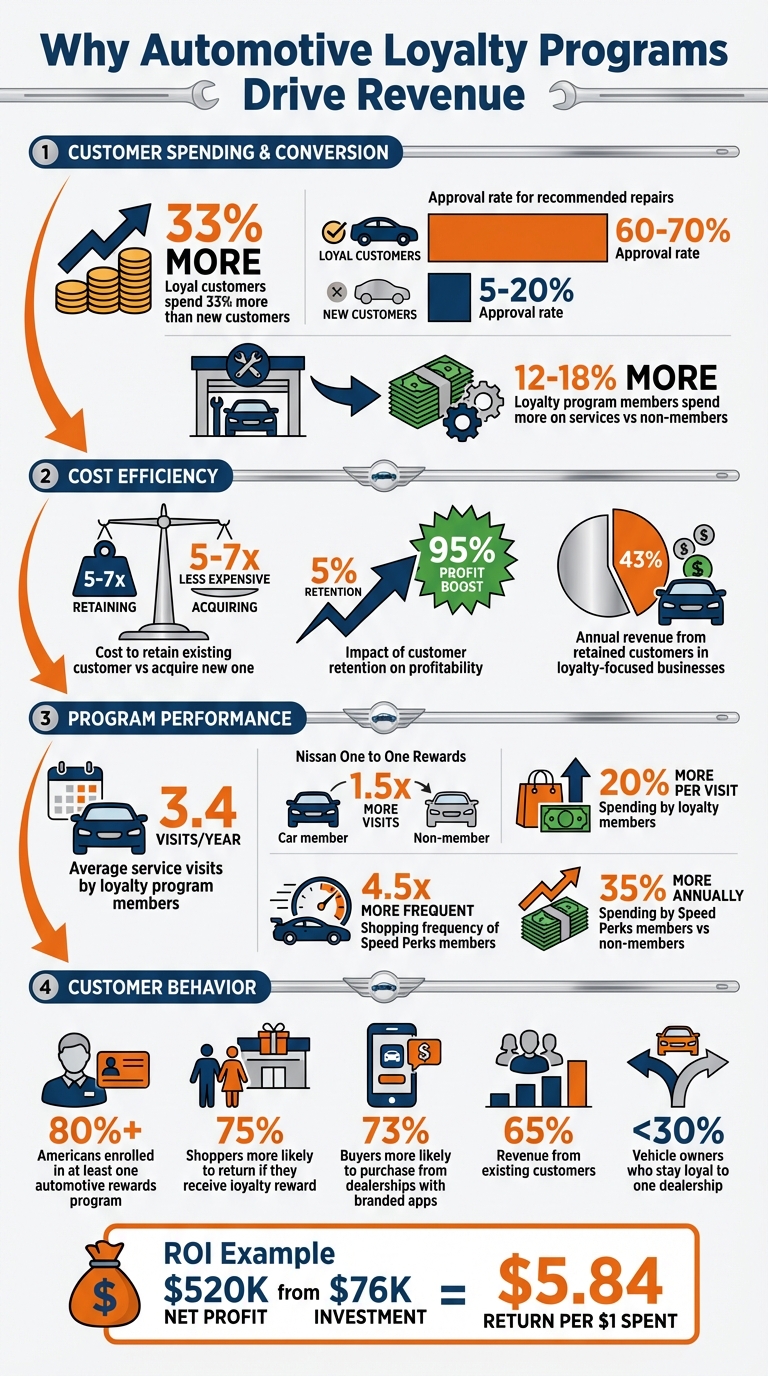
Want to keep customers coming back to your auto shop? Here’s the secret: loyalty programs. They reward repeat visits, increase spending, and build stronger customer relationships. For example, loyal customers spend 33% more and approve 60%-70% of recommended repairs, compared to just 5%-20% for new customers. Plus, keeping a customer costs 5-7 times less than acquiring a new one.
Key Takeaways:
- Start with clear goals: Retain customers, boost visit frequency, or encourage higher spending.
- Offer flexible rewards: Combine points, discounts, free services, and even perks for non-purchase activities like referrals or reviews.
- Use data to personalize offers: Tailor rewards based on service history, vehicle age, or real-time diagnostics.
- Incorporate technology: Automate sign-ups, track rewards, and integrate with apps for seamless user experiences.
- Promote engagement: Add gamification, tiered rewards (e.g., Silver, Gold), and household plans to increase participation.
- Connect with marketing: Use loyalty data to power SEO, PPC campaigns, and local partnerships.
Loyalty programs aren’t just about discounts – they’re about creating long-term value for your customers and your business. Ready to upgrade your approach? Keep reading for actionable tips to make it happen.
Automotive Loyalty Program Statistics: Customer Retention ROI and Impact
Program Design Best Practices
Set Clear Goals and Choose a Program Structure
Start by defining what you want your loyalty program to achieve. Are you aiming to retain customers, encourage more frequent visits, or increase overall spending? Once you know your goal, choose a program structure that aligns with it. Brian Schmid, Digital Marketing Manager at VinSolutions, breaks it down like this:
"Start by retaining customers, then getting them to come in more often, and then expanding what they buy when they come in".
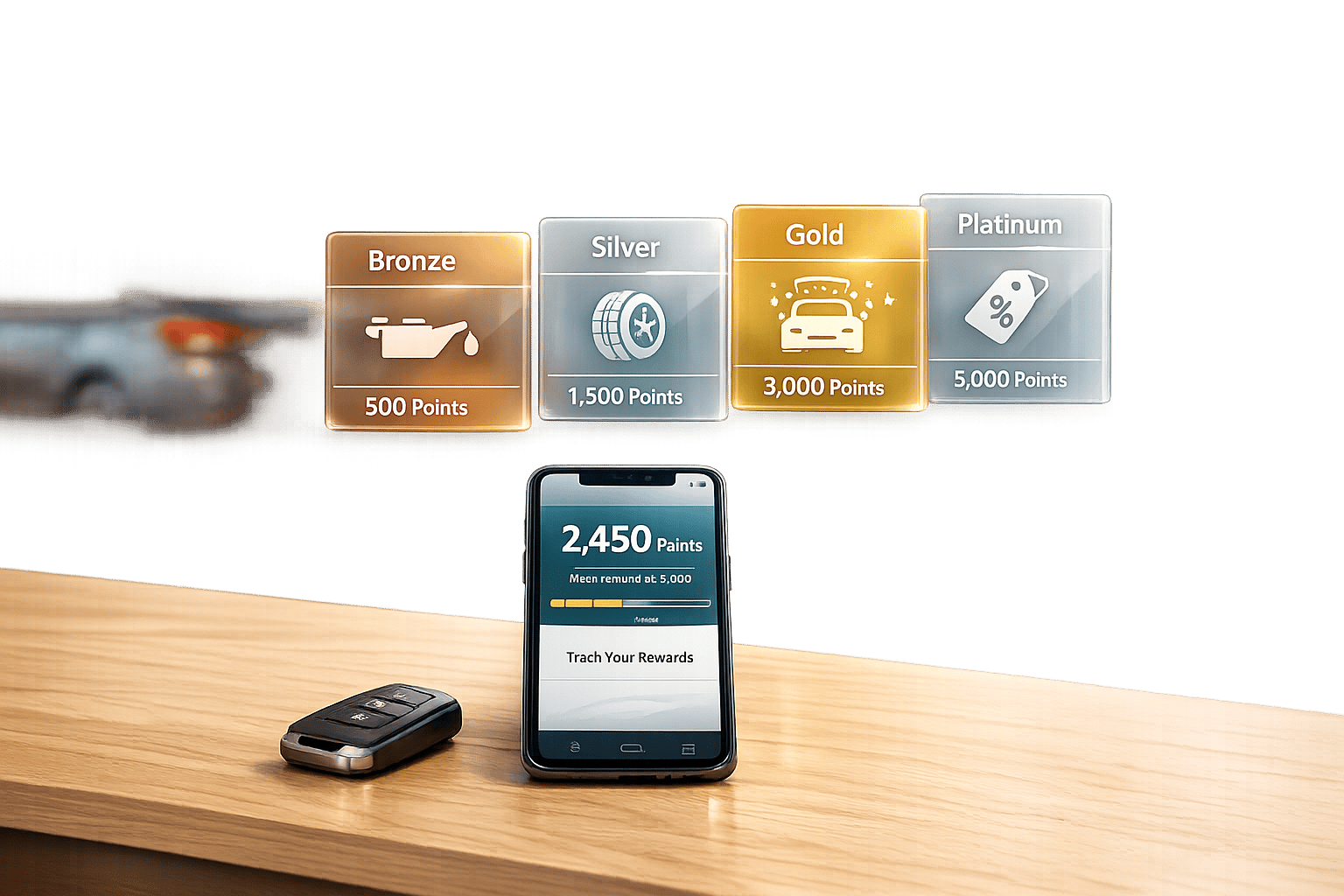
For general retention, a points-based system is a solid choice. Customers earn points for every dollar spent, which they can later redeem for discounts or free services. If you want to motivate customers to spend more or visit more often, consider a tiered program with levels like Silver, Gold, and Platinum. These programs reward higher spending with perks such as priority scheduling or exclusive offers. For businesses with high-frequency services, such as oil changes, a simple punch card – offering a free service after a set number of visits – can work wonders. For example, Ford’s FordPass Rewards program awards members 10 points per dollar spent, leading to a 35% increase in service retention among members compared to non-members as of May 2025.
Once your structure is in place, focus on creating rewards that appeal to a range of customer preferences.
Choose Flexible Reward Options
A successful loyalty program offers a mix of rewards to cater to different customer needs. Combine instant rewards, like discounts, with larger cumulative incentives such as free tire rotations or contributions toward vehicle purchases. Nissan’s One to One Rewards program lets members redeem up to $250 in points per transaction, and dealerships have observed that members visit more frequently and spend more per visit than non-members.
Don’t limit rewards to purchases alone. Recognize non-transactional activities like writing reviews, referring friends, or engaging with your shop on social media. Partnering with local businesses – like gas stations or car washes – can also add value by allowing customers to earn or redeem points at multiple locations. Volvo’s “Kronor Experience” program, which enhances rewards as vehicles age, has shown impressive results: a 45% increase in service visits for vehicles over five years old.
Add Gamification Elements
Gamification is a great way to keep customers engaged. Add milestones that unlock rewards, such as free car washes or priority scheduling, when customers hit spending or visit thresholds. You can also drive participation with time-sensitive offers like double points during slow periods or limited-time credits. Advance Auto Parts’ Speed Perks program uses these tactics effectively, with members shopping 4.5 times more frequently and spending 35% more annually than non-members as of May 2025.
sbb-itb-02fe772
Beyond the Repair Order: The Strategy of Customer Loyalty [RR 1077]
Personalization and Customer Engagement
To deepen customer loyalty, align rewards and communication strategies with individual service histories and preferences.
Use Customer Data to Personalize Rewards
Service records offer a goldmine of opportunities for tailored rewards. For instance, if a customer recently replaced their brake pads, you could automatically send them a discount on tires a few months later. This kind of AI-powered analysis taps into purchase patterns and service history to deliver highly relevant offers.
Connected car technology takes personalization even further. By using real-time diagnostics, you can trigger unique rewards – like double points – when a customer books a service within 30 days of receiving a vehicle alert. Programs such as Nissan’s One to One Rewards show how effective this approach can be. Members visited service centers 1.5 times more often and spent 20% more per visit compared to non-members. You can also adjust offers based on vehicle age, such as offering steeper discounts on parts for older cars, to keep customers coming back.
This level of precision ensures your most loyal customers feel recognized and valued.
Give Extra Benefits to Repeat Customers
Personalized offers are great, but adding tangible perks can further strengthen loyalty. Going beyond points, benefits like priority scheduling, free multi-point inspections, or complimentary tire rotations provide immediate value. Studies show that loyal customers spend 33% to 67% more than new ones, and retaining a customer can be far less expensive than acquiring a new one – 5 to 25 times less, to be exact.
Consider creating tiered loyalty levels, such as Bronze, Silver, and Gold, to motivate customers to engage more deeply. Higher tiers could include perks like concierge services or exclusive invites to special events. Offering rewards for future services instead of same-day work also encourages repeat visits. Additionally, tying rewards to a household rather than a single vehicle can bring in multiple family members, increasing overall engagement.
Communicate Across Multiple Channels
Effective communication is key to keeping customers engaged. Mobile apps are particularly powerful tools for service scheduling and tracking rewards. Customers using branded apps are 73% more likely to make purchases and book 25% more service appointments than those without. Text messages are another great option for timely updates, like notifying customers when they’ve earned a reward.
Don’t overlook in-person interactions, either. Adding QR codes to digital screens in your waiting area allows customers to join loyalty programs while their car is being serviced. By combining digital tools with face-to-face interactions, you can ensure your customers stay informed and connected at every step of their journey.
Technology and Implementation
Today’s software can turn your loyalty program into a fully automated system that’s easy for both customers and staff to use. For example, QR code integration simplifies sign-ups – customers can scan a code displayed on your waiting room screens and join the program directly from their phones while their car is being serviced. Linking your program to digital wallets like Apple Wallet and Google Wallet also allows for real-time updates on points and tier statuses.
Your loyalty software should work seamlessly with your existing Dealer Management System (DMS) and Customer Relationship Management (CRM) platforms. This integration ensures service history is tracked automatically, and rewards are triggered without any need for manual data entry by your team. Features like automated rule engines let you set priorities, constraints, and expiration dates for rewards, while geofencing technology can send push notifications when customers are near your dealership, reminding them of available rewards or upcoming services. An API-first architecture connects sales, service, and digital channels into a unified loyalty platform. Each of these tools plays a crucial role in increasing customer engagement and making your program more efficient.
Automate Sign-Ups and Reward Tracking
Manual enrollment can be a barrier to participation. With over 80% of Americans already part of at least one automotive rewards program, customers expect a fast, effortless sign-up process. By placing QR codes on digital screens in your service area, customers can register in under a minute while they wait.
Once enrolled, automation takes over. It tracks service visits, calculates points, and updates accounts without requiring any manual effort. Considering that loyalty program members spend 12% to 18% more on services compared to non-members, automation is not just convenient – it’s a smart investment that can lead to noticeable revenue growth.
Apply Data Analysis to Improve Your Program
Having raw data isn’t enough – it’s the insights you gain that make the difference. Data visualization dashboards allow you to monitor key performance indicators (KPIs) in real time. These tools can uncover patterns that traditional reports often miss, like which rewards are most popular, which customer groups are most active, and where engagement drops off.
Predictive modeling takes things a step further. Using machine learning algorithms, you can forecast customer behavior, estimate Customer Lifetime Value (CLV), and even detect fraud. Cloud-based platforms provide quick access to large datasets, making it easier to test new program features and adjust rewards based on real-world performance. For instance, Volvo found that tailoring rewards to older vehicles – like offering discounts on parts – led to a 45% increase in service visits for those cars. Regular data analysis ensures your program evolves in ways that meet customer needs while supporting your business goals.
Track Performance and Make Adjustments
Keeping a close eye on performance metrics is essential for running a successful loyalty program. For example, loyalty program members visit service departments an average of 3.4 times a year. Monitoring metrics like return rates, reward redemption rates, and churn rates will help you understand how well your program is performing and where it might need adjustments.
"Data visualization helps managers dynamically monitor program KPIs more effectively than outdated spreadsheet tables and graphs." – PwC
Using historical data, you can simulate how changes – like adjusting point values or redemption thresholds – might affect your program’s performance. This approach minimizes risk and helps you avoid costly mistakes. Tracking breakage rates (the percentage of unredeemed points) is another important step for accurate financial reporting. For example, Nissan dealerships using the One to One Rewards program reported that members visited for service 1.5 times more often and spent 20% more per visit than non-members. By consistently monitoring and refining your program, you can align it with your retention and engagement goals while ensuring it delivers measurable value.
Connecting Loyalty Programs with Marketing
Once you’ve established a well-designed and automated loyalty program, the next step is to connect it with your marketing initiatives. This integration allows you to use the rich customer data from your loyalty program – like service preferences, driving habits, and vehicle history – to craft highly targeted PPC segments and lookalike audiences. These strategies can help you attract similar high-value customers and boost engagement. Encouraging reviews and social shares through loyalty incentives can also enhance your local SEO and reputation.
Here’s a key insight: while 65% of revenue comes from existing customers, less than 30% of vehicle owners stay loyal to one dealership. This gap presents a massive opportunity to grow your market share by blending loyalty data with targeted marketing campaigns aimed at attracting and retaining high-value customers.
Use SEO and PPC to Bring in New Customers
Digital marketing channels like SEO and PPC are vital for drawing new customers into your loyalty program. When running PPC campaigns, make your ads stand out by emphasizing immediate rewards. For example, a message like "Join today for an instant $20 off your first oil change" can drive higher click-through rates and conversions by offering a clear and compelling reason to act.
Collaborating with specialists such as Auto Repair Leads Pro can further refine your efforts. They provide services like website development, search engine optimization, and pay-per-click advertising across platforms like Google, Meta, and Microsoft. These tools are designed to increase visibility and deliver quality leads to your automotive business.
To streamline the sign-up process, consider using QR-enabled enrollment. This smooth transition from lead to loyalty member is critical, especially since 75% of shoppers are more likely to return if they receive a loyalty reward.
Referral programs are another powerful tool for customer acquisition. By rewarding current members for bringing in new customers, you effectively turn them into brand ambassadors – without the high costs of traditional advertising. This approach is not only cost-efficient but also leverages the fact that it costs five to seven times more to attract a new customer than to retain an existing one.
Target Local Customers with Loyalty Offers
Loyalty programs can have a significant impact when tailored to local customers. By customizing your offers based on local buying behaviors and partnering with nearby businesses – like gas stations, car washes, or tire shops – you can create cross-promotional rewards that appeal to local prospects. These partnerships make your program more enticing and foster a sense of community.
"Manage your automotive dealership loyalty programs by geography, i.e., by dealerships. They provide customized incentives by customer behavior and location." – Spyne
Location-based advertising is another effective strategy. For example, you can send push notifications about limited-time offers to customers near your shop or remind them of unused rewards. This real-time engagement leverages connected car technology and smartphones to reach customers at the right moment.
Household and family plans can further enhance your program’s appeal. By allowing loyalty benefits to be shared across vehicles within the same household, you encourage families to bring all their cars to your shop. This tactic is especially effective, as existing customers have a 60% to 70% chance of completing a repair, compared to only 5% to 20% for new customers. Localizing your offers not only drives customer engagement but also provides a practical way to measure how loyalty and marketing efforts work together to boost profitability.
Measure Combined Marketing and Loyalty Results
To fully understand the impact of your loyalty program and marketing efforts, it’s essential to track the right metrics. Start with Customer Acquisition Cost (CAC) and Customer Lifetime Value (CLV) to assess the long-term financial benefits of your strategy. A simple ROI formula – (Net Profit – Total Program Cost) / Total Program Cost – can help you evaluate your program’s profitability. For instance, if your shop earns a net profit of $520,000 after investing $76,000 in a loyalty program, you’re generating $5.84 in net profit for every dollar spent.
Other key metrics include loyalty attachment rates, repeat purchase rates, redemption rates, and churn rates. These indicators reveal where customers are most engaged and where they may be dropping off.
Using test and control groups or A/B testing can help isolate the effects of loyalty programs from broader marketing campaigns. Compare data from loyalty members versus non-members to refine your strategies. This method addresses a common challenge: your most loyal customers are often the first to join your program, making it tricky to determine whether their loyalty stems from the program itself or pre-existing habits.
The financial benefits of retention are hard to ignore. A 5% increase in customer retention can boost profits by up to 95%, and retained customers account for over 43% of annual revenue in loyalty-focused businesses. By consistently analyzing how your loyalty and marketing efforts work together, you can make informed adjustments to maximize both retention and acquisition.
Key Takeaways
Start by setting clear, measurable goals that align with your overall marketing vision. Dive into customer pain points and define specific objectives, such as increasing Customer Lifetime Value or boosting service frequency. Keep an eye on key performance indicators (KPIs) like sign-ups, churn rates, and average service value to measure your program’s return on investment. As Jamey Walsh from UPshow explains:
"The end goal is simple – reward your customers for continuing to rely on your services (or spreading the word via referrals to potential customers)".
Personalization and engagement are what elevate loyalty programs from average to exceptional. Use customer data to go beyond generic discounts and provide rewards tailored to individual preferences. For instance, offer a discount on tires shortly after a brake pad purchase. Tiered rewards – like Silver, Gold, and Platinum levels – can motivate customers to spend more. And don’t overlook "Surprise and Delight" strategies, such as sending birthday rewards. Customers enrolled in dealer loyalty programs typically spend 12–18% more on service compared to those who aren’t. Combine this with personalization and smart technology to maximize program impact.
Leverage technology to gain an edge. Make enrollment easy with QR codes in your waiting area, integrate loyalty passes with Apple and Google Wallets, and use AI-driven analytics to predict customer needs. Automate service reminders based on real driving habits and vehicle health data. A branded app can also make a big difference – buyers are 73% more likely to purchase from dealerships that offer one.
Lastly, train your staff to actively promote the program. As LoyaltyXpert highlights:
"Programs with strong staff support consistently outperform those lacking internal champions".
FAQs
Which loyalty program type fits my shop best?
The best loyalty program for your auto repair shop will depend on what you want to achieve and the type of customers you serve. Tiered programs are great for motivating customers to visit more often and spend more by offering better rewards as they climb the tiers. On the other hand, point-based systems keep things straightforward – customers earn points for services and can trade those points for discounts. The key is to pick a program that fits your shop’s goals and appeals to your customers’ preferences to build stronger relationships and keep them coming back.
What rewards actually motivate auto customers?
Auto customers are drawn to rewards that make them feel appreciated and offer real benefits. These include personalized incentives, loyalty points, VIP perks, discounts, priority service, and even gamified challenges. Such strategies not only enhance engagement but also encourage repeat business by creating a sense of value and rewarding their continued support.
How do I measure loyalty program ROI?
To evaluate the success of a loyalty program, focus on tracking key performance metrics that directly tie to its effectiveness. Metrics like incremental revenue, profit, customer lifetime value (CLV), redemption rates, and repeat purchases offer valuable insights into how the program influences customer behavior.
The most important step? Establishing a clear link between the loyalty program and measurable increases in profitability. This connection is essential to proving its impact and ensuring the program delivers tangible benefits for your business.