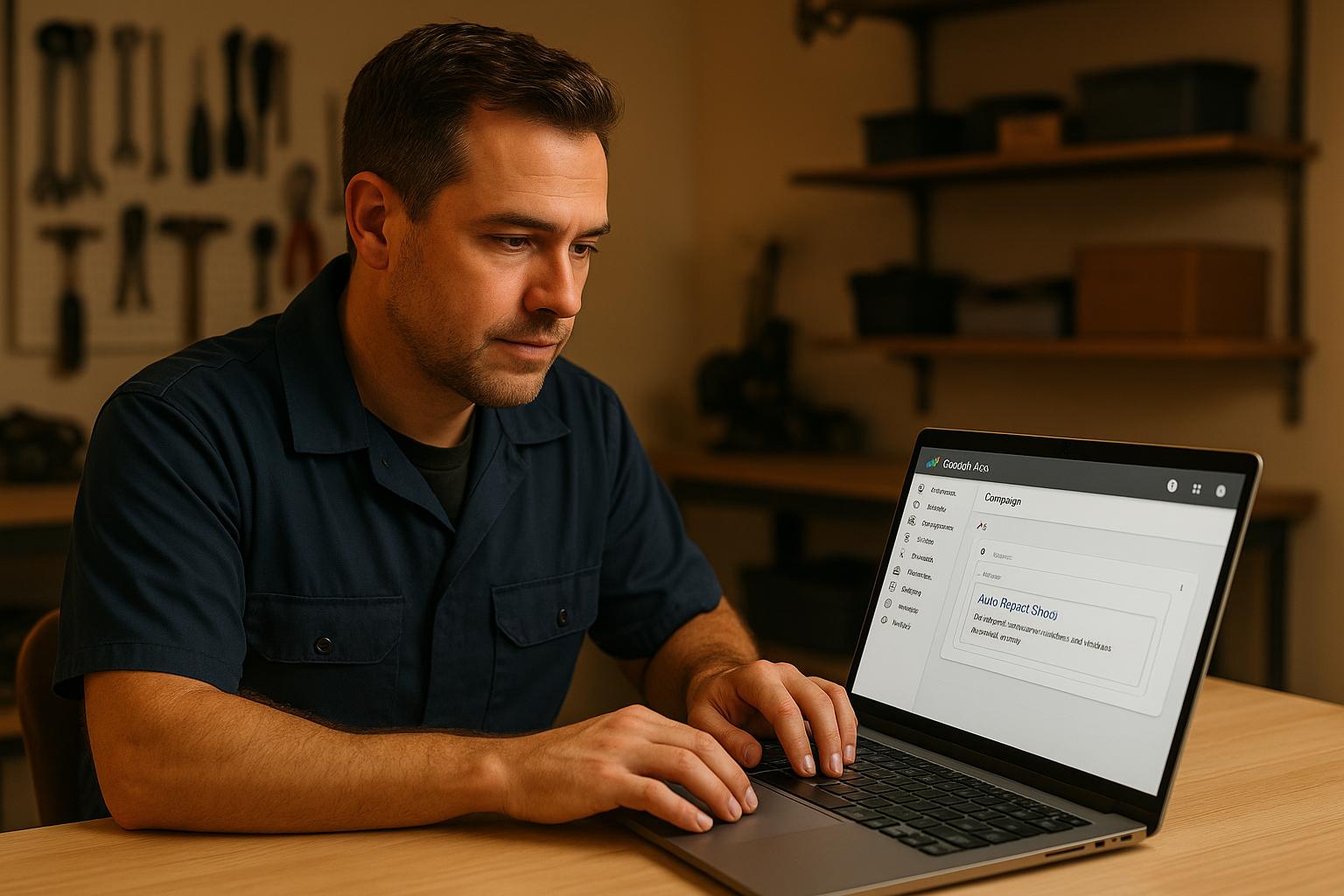
Auto repair shops often struggle with marketing budgets, leading to wasted ad spend and unclear results. Here’s how to fix that.
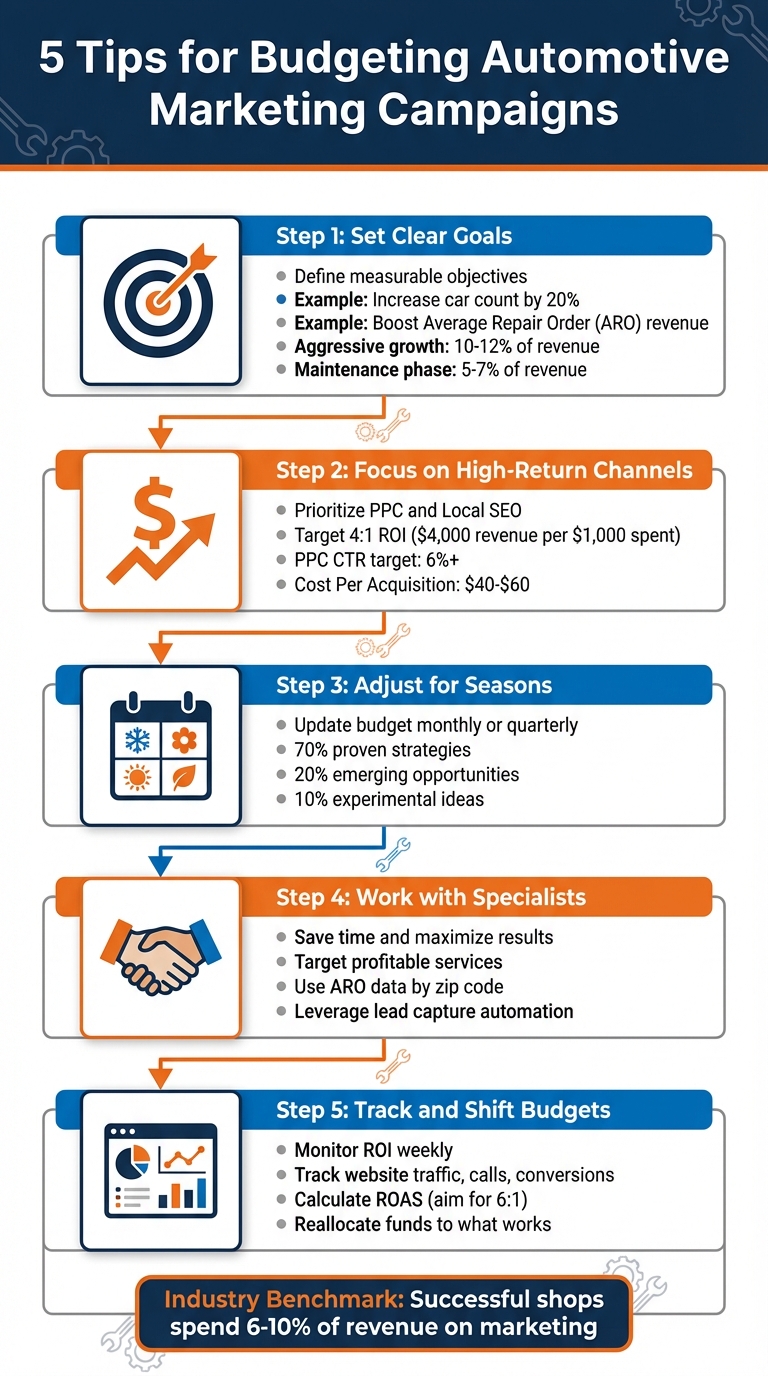
- Set Clear Goals: Define measurable objectives like increasing car count by 20% or boosting average repair order (ARO) revenue.
- Focus on High-Return Channels: Invest in PPC and local SEO to target ready-to-act customers.
- Adjust for Seasons: Update your budget monthly or quarterly to align with seasonal demand.
- Work with Specialists: Partner with marketing pros to save time and maximize results.
- Track and Shift Budgets: Monitor key metrics like ROI and reallocate funds to what works.
Quick Tip: Successful shops spend 6–10% of revenue on marketing, prioritizing strategies with proven returns like Google Ads and local SEO.
5 Essential Steps for Budgeting Auto Repair Shop Marketing Campaigns
Boost Your Car Count with these Auto Repair Shop Marketing Strategies | Auto Repair Growth Workshop
1. Set Clear Goals Before Spending Money
Before diving into marketing expenses, it’s crucial to set clear, measurable objectives. Vague aspirations like "get more customers" don’t provide the direction needed to make smart budget choices. Instead, focus on specific, actionable goals that align with your shop’s priorities – such as increasing your Average Repair Order (ARO) by $50, growing your car count by 20% over the year, or filling up bays during slower times like the back-to-school season. Having this clarity ensures that every dollar you spend on marketing directly supports your shop’s unique needs.
These well-defined goals also serve as a guide when evaluating marketing opportunities. For instance, if a sales rep pitches options like billboard ads or local sponsorships, you can quickly determine whether those ideas align with your objectives or are just distractions. Let’s say your aim is to attract customers who prioritize high-value services like factory-recommended maintenance or brake work, rather than bargain hunters looking for the cheapest deal. With that focus, you can direct your efforts toward marketing channels that appeal to quality-conscious car owners.
"Marketing to ‘anyone who drives a car’ is the fastest way to live a miserable life. You’ll attract clients who are broke… and who complain about everything."
ROI Maximization
Having clear goals helps you channel funds into initiatives with high returns. For example, a reasonable target for paid campaigns, such as Google Ads, is achieving a 4:1 return – generating $4,000 in revenue for every $1,000 spent monthly. Shops aiming for aggressive growth often allocate 10–12% of their gross revenue to marketing, while those in a maintenance phase typically spend around 5–7%. These percentages help you decide whether to push for expansion or maintain steady operations.
Performance Tracking and Analytics
Defined goals also make it easier to track progress and identify red flags early. Instead of waiting for end-of-month reports, keep an eye on weekly metrics like phone calls, website traffic, and contact form submissions. These indicators can forecast how well your campaigns are performing and give you the chance to tweak strategies before wasting money on ineffective efforts. Additionally, track metrics like quote capture rates and new customer acquisition rates to ensure your investments are driving results.
"Marketing performance doesn’t come with a ‘check engine’ light. If you don’t measure the right signals, it’s easy to assume things are working when they’re not."
- Paul Donahue, Owner, Advanced Digital Automotive Group
2. Focus on High-Return Channels Like PPC and Local SEO
Not every marketing channel delivers the same bang for your buck. By concentrating your budget on pay-per-click (PPC) advertising and local SEO, you ensure that every dollar is working to directly drive customer actions. These two strategies are especially effective for auto repair shops because they target customers at the exact moment they’re ready to act. Think about it: when someone searches for "brake repair near me" or "emergency towing", they’re not just browsing – they’re ready to book. PPC places your shop right at the top of those search results immediately, while local SEO ensures your business appears prominently in the "Local Pack", which is often the first thing users see on mobile devices. Considering that about 59% of people check Google Reviews before visiting a shop, having a strong local presence is key to turning searches into appointments.
ROI Maximization
Both PPC and local SEO offer measurable returns that make them standout investments. A well-executed PPC campaign can generate a 4:1 return, meaning a $1,000 monthly ad budget could bring in $4,000 in revenue. To get the most out of your PPC efforts, focus on targeting a 3–10 mile radius around your shop to avoid wasting money on irrelevant clicks. Also, prioritize high-margin services like diagnostics or brake repairs instead of lower-profit options like oil changes. For local SEO, optimizing your Google Business Profile is a game-changer. Ensure your profile has accurate business hours, a clear list of services, and up-to-date contact information – these details can significantly improve your visibility in local searches.
"ROI isn’t just getting clicks. It’s getting the right kind of calls, from the right kind of customers, at a cost that leaves you room for profit."
- Paul Donahue, Owner, Advanced Digital Automotive Group
Performance Tracking and Analytics
The secret to successful campaigns lies in tracking the right metrics. For PPC, keep an eye on your Click-Through Rate (CTR) (aim for at least 6%) and ensure your Cost Per Acquisition (CPA) stays between $40 and $60. Also, monitor long phone calls, contact form submissions, and booked appointments to measure real customer engagement. With local SEO, track rankings for high-intent keywords and analyze clicks on "directions" or "call now" buttons. Reviewing these metrics weekly allows you to make adjustments quickly, rather than waiting for monthly revenue reports to confirm what’s already working – or not.
Specialized Marketing Services
Managing PPC and local SEO effectively takes industry-specific expertise. That’s where companies like Auto Repair Leads Pro (https://autorepairleadspro.com) come in. They specialize in creating service-specific landing pages that turn web traffic into booked appointments and optimizing Google Business Profiles to dominate local searches. By combining PPC for immediate lead generation with SEO for sustainable growth, they ensure your marketing dollars deliver results both now and in the long run.
3. Adjust Your Budget Based on Seasons and Performance
Managing your budget isn’t a one-and-done task. Auto repair demand shifts with the seasons – think AC repairs ramping up in spring or winter prep services gaining traction in the fall. Instead of sticking rigidly to an annual budget, start with a flexible plan and update it monthly or quarterly. This approach keeps your spending aligned with both seasonal trends and your shop’s performance metrics.
Seasonal Budget Adjustments
Successful shops don’t leave seasonal trends to chance. They analyze key indicators like search data and website traffic spikes to anticipate demand. For example, if searches for "brake inspection" increase in early fall or "coolant flush" gains traction in spring, it’s time to shift your budget toward those services before the rush begins. Broadly advises, "The time to invest is often when your business is most active, helping to fill your repair order pipeline for slower periods".
If certain tactics underperform – say, an email campaign with low engagement – redirect that budget to more effective channels like PPC ads or local SEO. A good rule of thumb is the 70-20-10 approach: dedicate 70% of your budget to proven strategies, 20% to emerging opportunities (like video content), and 10% to experimental ideas.
Performance Tracking and Analytics
Seasonal insights are just the beginning. Regular tracking of your shop’s performance ensures your budget remains effective over time. Weekly and monthly reviews help you make timely adjustments, whether it’s reallocating funds between SEO and PPC or fine-tuning conversion strategies. Metrics like keyword rankings, click-through rates, and ad performance can guide these short-term shifts.
On a quarterly basis, dig deeper into revenue trends, customer retention, and Average Repair Order (ARO) to assess your long-term strategy. This structured review process prevents knee-jerk reactions to short-term changes while helping you identify real trends early.
"Marketing is like vehicle maintenance: the shops that monitor performance regularly and make small, smart adjustments are the ones that stay ahead."
- Paul Donahue, Owner, Advanced Digital Automotive Group
sbb-itb-02fe772
4. Work with Marketing Specialists Like Auto Repair Leads Pro
Running an auto repair shop is a demanding job. Between managing service appointments, overseeing technicians, and addressing customer concerns, there’s often little time left to focus on effective marketing. As Shop Marketing Pros aptly puts it, "The owner of the business is usually the last person who should be marketing the business". When marketing becomes an afterthought, it’s often inconsistent – or worse, neglected entirely. That’s where working with marketing specialists can make a real difference.
Why Marketing Specialists Matter
Marketing specialists bring a sharp focus to your efforts. They know how to zero in on your most profitable services – the ones that keep your high-cost equipment in use rather than sitting idle. Instead of wasting your budget on every possible platform, they identify where your ideal customers spend their time online and tailor campaigns to reach them effectively.
Take Auto Repair Leads Pro, for example. They offer services like lead-generating websites, local SEO, and PPC advertising designed to turn clicks into booked appointments. By leveraging advanced analytics, they ensure every marketing dollar is tied directly to measurable results.
Getting the Most from Your Marketing Budget
Partnering with specialists doesn’t just free up your time – it also helps you get more bang for your buck. Successful shops typically invest 6%–10% of their gross revenue into marketing to see the best returns. Marketing experts help you avoid wasting money on ineffective channels, using tools like lead capture automation to make sure no potential customer slips through the cracks.
They also use ARO (average repair order) data by zip code to target neighborhoods with higher-value customers. This approach ensures your advertising dollars go to areas likely to generate bigger-ticket jobs, rather than being spread thin across less profitable regions. As Autoshop Solutions wisely notes: "In successful businesses, marketing drives revenue, not the other way around".
5. Monitor Results and Move Money to What Works
Marketing isn’t a “set it and forget it” kind of deal. The shops with the best returns treat their campaigns like tuning up a vehicle – spotting small issues and fixing them before they turn into costly problems.
Performance Tracking and Analytics
The secret to separating profitable campaigns from money pits lies in tracking the right metrics. Early indicators like website traffic, call volume, and search trends act as your first warning signs. On the other hand, lagging indicators – such as total revenue, booked appointments, and Average Repair Order (ARO) – show what’s already happened. Many shops make the mistake of relying only on these lagging indicators to guide their spending. By the time a revenue report flags a problem, you’ve likely wasted weeks of ad spend.
Tools like Google Analytics can help you dig deeper. For example, it can show whether visitors are leaving your site right away or exploring key pages like your services section before making a call. This post-click behavior reveals whether you’re attracting serious customers or just casual browsers. For PPC campaigns, track both direct calls from the ad and those made after a visitor clicks through to your website. These numbers give you a clearer picture of real customer engagement.
By analyzing these metrics, you can make smarter decisions about where to put your ad dollars.
ROI Maximization
To measure ad performance, calculate your Return on Ad Spend (ROAS). Divide the revenue generated by your ads by your total ad spend. For instance, if a $2,000 investment brings in $12,000, you’ve achieved a 6:1 ROAS – a solid benchmark for automotive Google Ads campaigns.
Boosting ROI doesn’t always mean spending more. Simple changes to your landing pages can make a big difference. Add click-to-call buttons at the top of the page, and place trust-building elements like customer reviews or warranties near your call-to-action buttons.
Another way to save money is by fine-tuning your PPC campaigns with negative keywords. For instance, if your shop specializes in transmissions, adding “oil change” as a negative keyword ensures you’re not paying for clicks from bargain hunters looking for unrelated services. These small adjustments can significantly lower your cost per lead without increasing your budget.
Seasonal Budget Adjustments
Because market conditions are always shifting, staying on top of your budget is critical. Beyond immediate tweaks, it’s important to account for seasonal trends. Review your leads, calls, and form submissions weekly to catch potential issues early. On a monthly basis, evaluate channel performance – like SEO versus PPC – along with conversion rates and cost per lead. Then, conduct quarterly audits to analyze revenue patterns, customer retention, and seasonal trends. This approach allows you to plan your next three months of spending with confidence.
Conclusion
A well-planned budget isn’t about spending more – it’s about spending smarter. The most successful shops cut out unnecessary expenses, focus their resources on channels that deliver results, and adapt their strategies based on actual performance data.
Start by creating a clear budget and directing funds toward channels with a track record of strong ROI. Digital approaches like Local SEO and PPC advertising stand out because they offer precise tracking and targeting compared to traditional media. You can see exactly where your money is going and how it’s performing. Throughout the year, keep refining your budget. Using a 12-month rolling calendar helps you anticipate seasonal slowdowns and plan promotions to keep your shop busy even during quieter periods.
To execute these strategies effectively, consider working with specialists like Auto Repair Leads Pro. Their expertise can help you implement a data-driven approach while you focus on managing your shop. With tools like weekly scorecards that track calls, bookings, and Average Repair Order (ARO), you’ll have a clear view of how your marketing dollars are translating into revenue.
Think of your marketing budget as a key part of your shop’s overall efficiency. Keep a close eye on it, make adjustments when something isn’t working, and don’t hesitate to invest in expert support to maximize your results. By applying these five budgeting strategies, you’ll eliminate waste and focus on tactics that truly boost your bottom line.
FAQs
How do I set the right marketing budget for my auto repair shop?
To figure out the right marketing budget for your shop, start by aligning it with your annual revenue and growth objectives. Begin by calculating your gross annual revenue – this is your total sales before any deductions. Next, decide on your growth target: conservative growth (maintaining your current customer base), moderate growth (aiming for a 10-25% annual increase), or aggressive growth (focused on rapid expansion or in the early startup phase). A common rule of thumb is to allocate 5% of revenue for conservative growth, 7% for moderate growth, and 9-12% for aggressive growth.
Once you’ve determined a percentage-based budget, divide it across different marketing channels. A good starting point is to dedicate at least half of your budget to local and community-centered efforts, like hosting workshops or events. The remaining portion can go toward digital strategies, such as local SEO, pay-per-click advertising, social media campaigns, and reputation management. If you’re uncertain about how to allocate your budget for the best results, Auto Repair Leads Pro can help design a customized plan to maximize your ROI.
How can I measure the success of my automotive marketing campaigns?
To evaluate how well your automotive marketing campaigns are performing, focus on tracking key performance indicators (KPIs) that align with your business objectives. Start by monitoring website traffic and its sources – whether it’s coming from organic search, paid ads, social media, or email campaigns. This helps pinpoint which channels are bringing in the most relevant visitors. Keep an eye on click-through rates (CTR) for your ads and emails to measure engagement, and track the number of qualified leads that match your ideal customer profile.
Another crucial metric is your conversion rate – the percentage of visitors completing desired actions, like scheduling a service or requesting a quote. Pair this with your cost per conversion to see how effectively your budget is turning visitors into paying customers. For paid campaigns, metrics like return on investment (ROI) and return on ad spend (ROAS) are essential for understanding profitability. Regularly reviewing these numbers allows you to spot top-performing channels, adjust your strategy, and fine-tune your spending for better results.
To make this process easier, Auto Repair Leads Pro offers real-time analytics through a single dashboard. Their tools provide insights into lead tracking, conversion measurement, and ROI calculation, helping you refine your marketing approach and get the most out of your investment.
Why should I hire marketing experts for my auto repair business?
Hiring marketing professionals for your auto repair business ensures your advertising budget works hard to deliver measurable results. These experts understand how to strategically allocate the recommended 7–8% of your revenue toward marketing, helping you avoid wasting money on ineffective tactics while still attracting enough new customers to grow your business.
Marketing specialists also bring the know-how to manage and fine-tune campaigns like SEO, pay-per-click (PPC) advertising, and review management. They monitor key performance metrics to see what’s driving results and make adjustments where needed, ensuring every dollar spent delivers the best possible return. This frees you up to focus on what you do best – providing top-notch repairs – while they handle the complexities of marketing.
Auto Repair Leads Pro offers customized marketing solutions tailored specifically for auto repair shops. Their services include custom website development, SEO, PPC advertising, and advanced analytics, all designed to help you generate steady, high-quality leads.